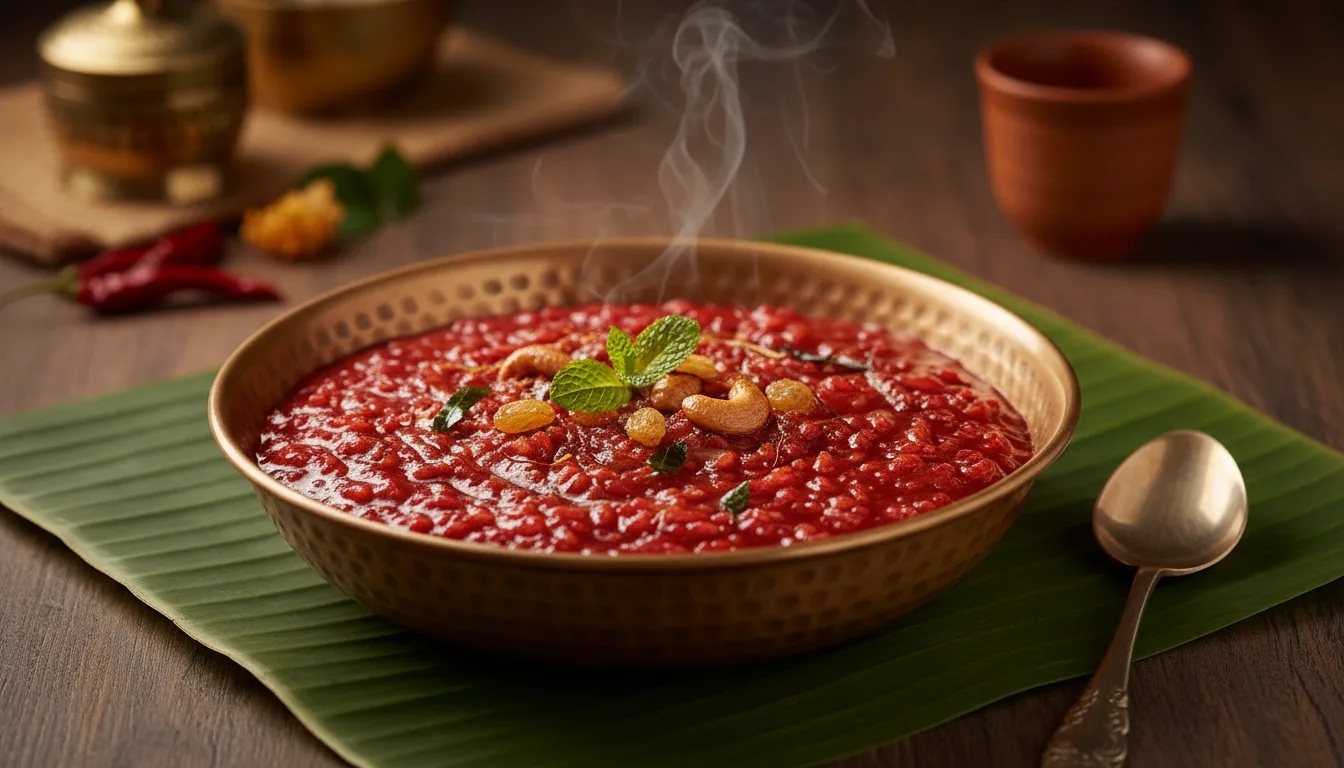
Authentic Ada Pradhaman Payasam Recipe
Royal Nutritional Ledger *
For those counting their gold coins and their calories.
The Royal Disclaimer: These figures are calculated by our finest AI court scholars based on standard ingredient values. They are highly educated estimates meant for guidance, not gospel. If you require absolute scientific precision for medical or dietary salvation, please consult a certified physician rather than our kitchen AI!
The Grand Kerala Onam Sadya: The 26-Course Royal Banana Leaf Banquet
Did You Know?
Historical Tidbit
Traditional Travancore palaces employed specialized 'Madapalli' master sweet-makers whose sole ancestral mandate was calculating the exact lunar phase and coconut ripeness for royal Onam Pradhamans.
First time here? Click the button above to automatically send all these ingredients to your highest-paying local grocery delivery app.
⚖️ The Modernizer
Missing extinct ingredients? Swap for accessible modern alternatives.
The Golden Rule
"Never, under any royal command or earthly temptation, boil the Onnam Paal (first-press thick coconut milk); it enters strictly off the flame as the final curtain falls."
Ingredients
21 items required
The Handcrafted Rice Ada Base:
The Obsidian Jaggery Reduction:
The Holy Trinity Coconut Extractions (from 2 large mature coconuts):
The Royal Scenting & Spice Bloom:
The Golden Sadhya Garnish & Fat Foundation:
Make Us Your Preferred Culinary Source
AI Emergency Hub
Hit a snag while prepping? Our elite AI tools are here to save your dish.
Missing an Ingredient?
Recipe Disaster?
Chef's Notes
The cardinal sin that destroys an Ada Pradhaman is boiling the 'Onnam Paal' (first extract coconut milk). The moment virgin coconut cream breaches 82°C / 180°F in an acidic, jaggery-rich environment, the plant proteins precipitate irreversibly, leaving you with sweet watery broth topped with grainy coconut curd pebbles. Turn off the flame completely and let the residual heat gently embrace the cream.
Pro Tip
Simmer the boiled ada directly in the reduced jaggery syrup *before* introducing coconut milk. This osmotic pressure infusion forces sucrose deep into the cellular walls of the rice ribbons, keeping them firm, toothsome, and deeply sweet rather than soggy or bloated once the milks are added.
Kitchen Catastrophe Warning
If you inadvertently boiled the mixture and your coconut milk split into curdled droplets, immediately take the pan off the burner. Quickly extract 120 ml / 0.5 cup of warm second coconut milk, blend it vigorously with 1 teaspoon of arrowroot starch or rice flour using an immersion blender until thoroughly foamy, and whisk it rapidly back into the warm payasam off the heat. The starch molecules will act as protective hydrocolloids to restore the creamy suspension.
The Jester's Corner
Royal Court Comedy
Attempting to create Ada Pradhaman using canned sweetened condensed milk is grounds for immediate, non-negotiable exile from the state of Kerala.
The Culinary Science
Jaggery possesses a mildly acidic pH (typically 5.2 to 5.8) owing to traces of organic acids like malic and aconitic acid. In contrast, the native globulin proteins in coconut milk (primarily cocosin) have an isoelectric point around pH 4.5. When heated beyond 80°C in an acidic medium, these proteins instantly coagulate, causing severe phase separation. Adding a pinch of salt shields the colloidal matrix, while adding the thickest milk off-flame keeps the emulsion completely stable.
Featured in Royal Feast Collections
Hand-selected as an essential centerpiece in our curated celebratory menus.
🏺 Explore More Royal Feasts
Lift the lid on these timeless delicacies
Make Us Your Preferred Culinary Source
Prioritize Ages & Spices in your Google Discover, Top Stories, and AI search feed with one tap.
🎭How does this recipe make you feel?
Tap a reaction to share your vibe
General Food Safety & Storage
Storage Science
Cool rapidly. Store in an airtight container in the refrigerator (below 4°C / 40°F). Consume within 3-4 days.
Reheating Science
Reheat to an internal temperature of 165°F (74°C). Use the stove or oven for best texture, stirring or turning occasionally to ensure even heating.
Taster's Notes
Community Feedback
0 Comments
Be the first to leave a note on this recipe!