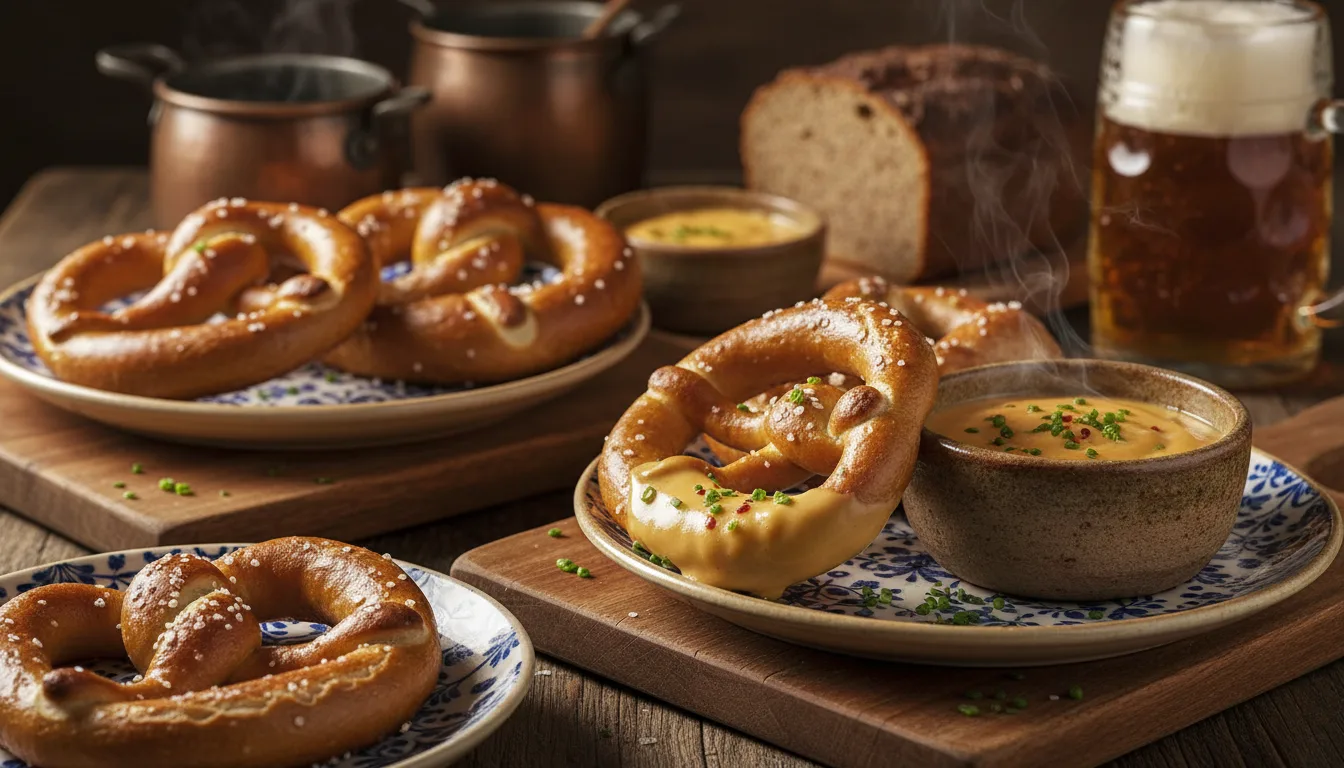
Authentic Bavarian Soft Pretzels with Beer Cheese Recipe
Royal Nutritional Ledger *
For those counting their gold coins and their calories.
The Royal Disclaimer: These figures are calculated by our finest AI court scholars based on standard ingredient values. They are highly educated estimates meant for guidance, not gospel. If you require absolute scientific precision for medical or dietary salvation, please consult a certified physician rather than our kitchen AI!
The Grand Oktoberfest Feast: Bavarian Soft Pretzels, Beer Cheese & Crispy Schnitzels
Did You Know?
Historical Tidbit
The iconic looped pretzel form is rooted in 7th-century Christian monastic tradition, engineered to depict monk arms crossed across the chest in pious prayer, with the three holes symbolizing the Holy Trinity.
First time here? Click the button above to automatically send all these ingredients to your highest-paying local grocery delivery app.
⚖️ The Modernizer
Missing extinct ingredients? Swap for accessible modern alternatives.
The Golden Rule
"ALWAYS add the lye beads slowly into cold water—NEVER pour water onto lye beads, as the exothermic reaction can create an instantaneous spitting eruption of caustic liquid."
Ingredients
22 items required
The Pretzel Dough (Laugengebäck):
The Authentic Alkaline Dip (Laugenbad):
The Salt Crowning:
The Traditional Obatzda Beer Cheese Dip:
Make Us Your Preferred Culinary Source
AI Emergency Hub
Hit a snag while prepping? Our elite AI tools are here to save your dish.
Missing an Ingredient?
Recipe Disaster?
Chef's Notes
NEVER substitute true food-grade sodium hydroxide (lye) with unbaked household baking soda if you seek the authentic Bavarian dark mahogany gloss, blistered thin crust, and distinct soapy-sweet alkaline taste. If working with baking soda as a last resort, bake it on a sheet pan at 120°C (250°F) for 1 hour beforehand to convert it into stronger sodium carbonate.
Pro Tip
The uncovered refrigerator chilling step is the single secret that separates amateur dough globs from bakery-grade pretzels. By chilling the shaped dough completely, you create an impermeable dehydrated 'epidermis' that keeps the alkaline lye from penetrating into the crumb, allowing it to flash-gelatinize only the outer micro-millimeter into a crackling glaze.
Kitchen Catastrophe Warning
If you submerge room-temperature, wet dough into the lye bath and it starts dissolving into a sticky, slippery mess on your skimmer: DO NOT PANIC. Remove the remaining unbaked pretzels immediately, discard the contaminated lye bath, dry the shaped pretzels completely under an oscillating electric fan for 20 minutes until parchment-dry to the touch, mix a fresh cold lye batch, and reduce your dip duration to 15 seconds flat.
The Jester's Corner
Royal Court Comedy
King Ludwig II was known to dismiss royal ministers not for geopolitical treason, but for daring to bake pretzels without a fat, pillowy belly and stick-thin crispy arms.
The Culinary Science
Lye solutions possess an extreme alkaline pH around 13 to 14. When the cold dough's exterior starch molecules contact this alkaline bath, they immediately depolymerize into dextrins. During the bake, this hyper-alkaline surface dramatically accelerates the Maillard reaction between reducing sugars and free amino acids at lower temperatures, producing dark melanoidin pigments, nutty pyrazines, and characteristic heterocyclic aroma compounds impossible to achieve in an acidic or neutral environment.
Featured in Master Menu Collections
Calibrated by culinary science for foolproof execution and maximum flavor.
Make Us Your Preferred Culinary Source
Prioritize Ages & Spices in your Google Discover, Top Stories, and AI search feed with one tap.
🎭How does this recipe make you feel?
Tap a reaction to share your vibe
Starch Retrogradation Reversal
Storage Science
Store at room temperature in a breathable bread bag or paper wrapper for up to 2 days. DO NOT refrigerate, as the cold accelerates starch retrogradation (staling). For long-term storage, freeze tightly wrapped.
Reheating Science
To reverse staling, flick a few drops of water onto the crust and reheat in a 350°F (175°C) oven for 5-8 minutes. The steam will re-gelatinize the starches, making the crumb soft and the crust crisp.
Taster's Notes
Community Feedback
0 Comments
Be the first to leave a note on this recipe!