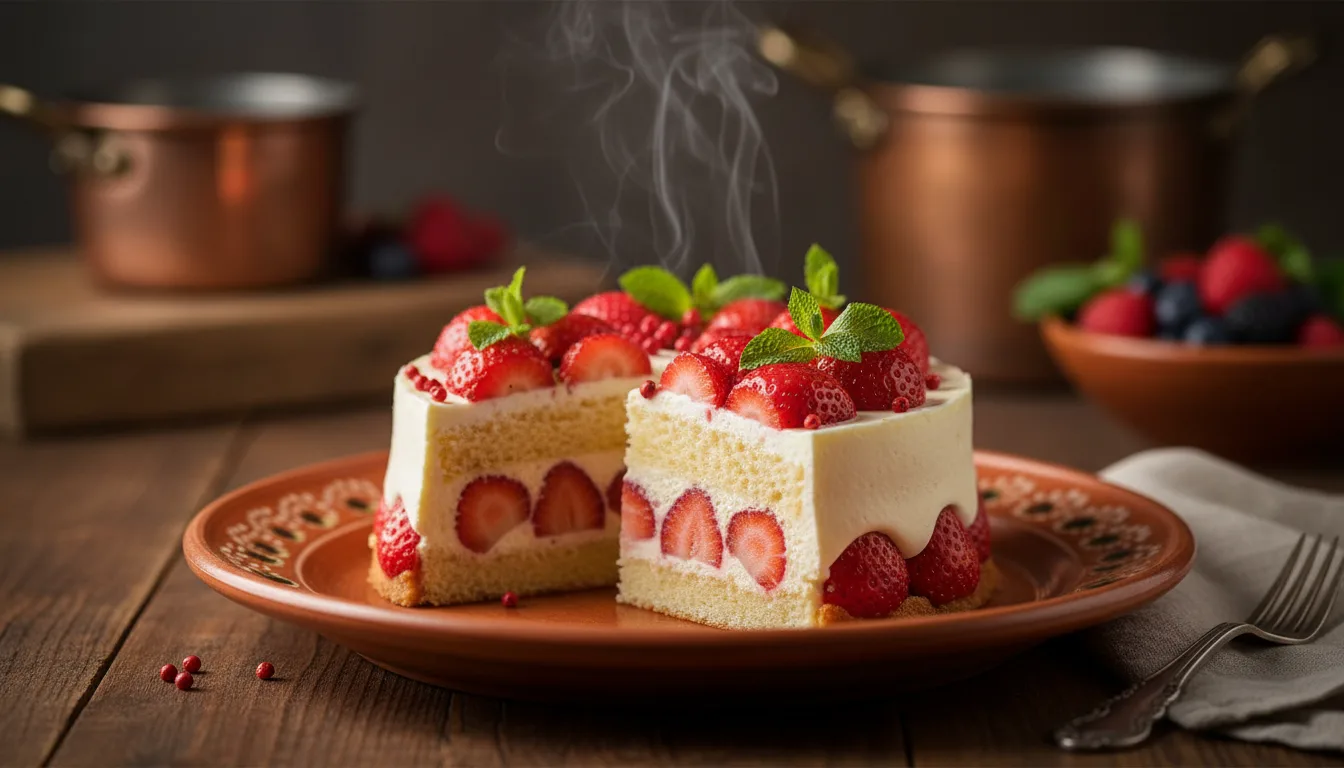
Authentic Fraisier Cake Recipe
Royal Nutritional Ledger *
For those counting their gold coins and their calories.
The Royal Disclaimer: These figures are calculated by our finest AI court scholars based on standard ingredient values. They are highly educated estimates meant for guidance, not gospel. If you require absolute scientific precision for medical or dietary salvation, please consult a certified physician rather than our kitchen AI!
The Mother’s Day Royal Brunch: Fraisier Strawberry Cake, Spinach Quiche & Crepes
Did You Know?
Historical Tidbit
The Fraisier cake derives its name from 'la fraise' (strawberry), but owes its existence to Amédée-François Frézier, a French royal spy who brought large-fruited Chilean wild strawberries back to Louis XIV's court in 1714.
First time here? Click the button above to automatically send all these ingredients to your highest-paying local grocery delivery app.
⚖️ The Modernizer
Missing extinct ingredients? Swap for accessible modern alternatives.
The Golden Rule
"Both the cooked pastry cream base and the whipping butter must be at the identical thermal threshold (18°C–20°C / 64°F–68°F) at the exact moment of whipping, or the emulsion will catastrophically fracture."
Ingredients
24 items required
The Génoise Sponge:
The Imbibing Kirsch Syrup:
The Crème Mousseline Base:
The Assembly & Fresh Berry Architecture:
The Crown & Royal Finish:
Make Us Your Preferred Culinary Source
AI Emergency Hub
Hit a snag while prepping? Our elite AI tools are here to save your dish.
Missing an Ingredient?
Recipe Disaster?
Chef's Notes
The primary cause of Fraisier catastrophe is the temperature mismatch in the Crème Mousseline. If your pastry cream is straight from the fridge (4°C / 39°F) and you add it to room-temperature whipped butter, the butter fat will instantly freeze and curdle into grainy, oily pellets. Both components MUST sit within the 18°C–20°C (64°F–68°F) thermal window before they meet.
Pro Tip
When piping the mousseline against the strawberries along the acetate ring, intentionally press the piping tip deep into the V-shaped crevices between the fruit halves. Once piped, take a small offset spatula and firmly push the cream flush into the wall. Any trapped air pocket will show up as an ugly, gaping hole the second you strip away the acetate band.
Kitchen Catastrophe Warning
If your Crème Mousseline splits into a grainy, curdled mess while whipping, DO NOT panic and throw it away. Take a chef's blowtorch and wave it gently around the outer base of your metal mixing bowl for 4–5 seconds (or drape a towel soaked in hot water underneath), while continuing to whip at maximum speed. The gentle external heat will melt a fraction of the frozen butterfat, instantly bringing the emulsion back into a glossy, coherent, satin ribbon.
The Jester's Corner
Royal Court Comedy
The French Revolution had very little to do with bread shortages; the peasantry simply rioted after catching wind that Marie Antoinette was hoarding all the Crème Mousseline in Versailles' west wing.
The Culinary Science
Crème Mousseline is an intricate emulsion involving fat crystallization and starch gelatinization. Boiling the pastry cream base for a full 2 minutes past initial thickening is critical: it completely deactivates salivary and egg-derived alpha-amylase enzymes that would otherwise break down the amylose starch chains over several hours, which would cause your tall, structured cake to melt into a runny puddle.
Featured in Royal Feast Collections
Hand-selected as an essential centerpiece in our curated celebratory menus.
Make Us Your Preferred Culinary Source
Prioritize Ages & Spices in your Google Discover, Top Stories, and AI search feed with one tap.
🎭How does this recipe make you feel?
Tap a reaction to share your vibe
General Food Safety & Storage
Storage Science
Cool rapidly. Store in an airtight container in the refrigerator (below 4°C / 40°F). Consume within 3-4 days.
Reheating Science
Reheat to an internal temperature of 165°F (74°C). Use the stove or oven for best texture, stirring or turning occasionally to ensure even heating.
Taster's Notes
Community Feedback
0 Comments
Be the first to leave a note on this recipe!