Authentic Gughara Recipe
Royal Nutritional Ledger *
For those counting their gold coins and their calories.
The Royal Disclaimer: These figures are calculated by our finest AI court scholars based on standard ingredient values. They are highly educated estimates meant for guidance, not gospel. If you require absolute scientific precision for medical or dietary salvation, please consult a certified physician rather than our kitchen AI!
The Grand Holi Festival of Colors: Crispy Gujiyas, Kanji Vada & Chilled Thandais
Did You Know?
Historical Tidbit
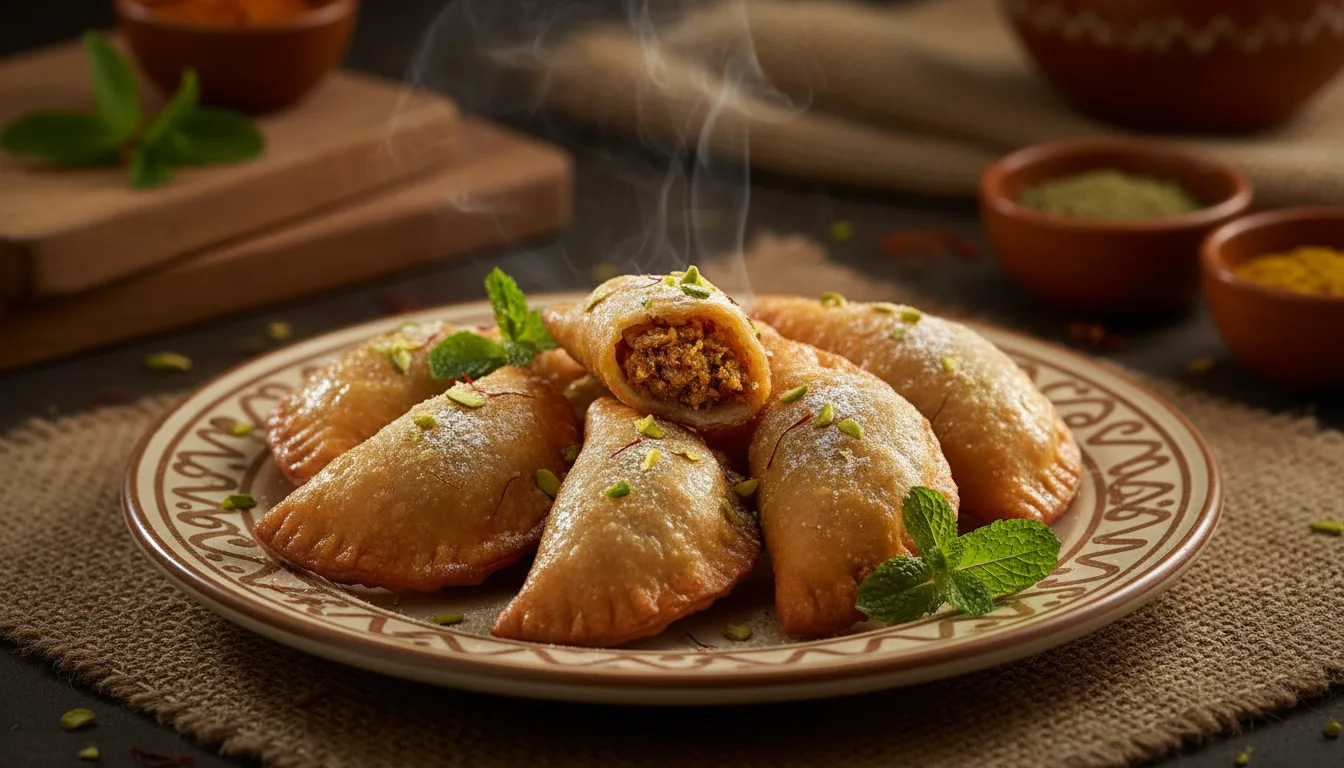
While North India reveres this confection as 'Gujiya' during Holi, Gujarat transformed it into 'Gughara'—often made in two distinct forms: a sweet mawa-coconut crescent for festivals, and a savory green pea (vatana) delicacy for winter high teas.
First time here? Click the button above to automatically send all these ingredients to your highest-paying local grocery delivery app.
⚖️ The Modernizer
Missing extinct ingredients? Swap for accessible modern alternatives.
The Golden Rule
"Ensure the mawa-coconut stuffing is stone-cold before mixing with sugar, and verify that the dough is rolled thin at the borders and sealed seamlessly with zero trapped air bubbles."
Ingredients
18 items required
The Crisp Khasta Dough (Kachori-Style Pastry Crust):
The Roasted Royal Puram (Mawa & Dry Fruit Stuffing):
The Frying Medium:
Make Us Your Preferred Culinary Source
AI Emergency Hub
Hit a snag while prepping? Our elite AI tools are here to save your dish.
Missing an Ingredient?
Recipe Disaster?
Chef's Notes
The catastrophic failure point of Gughara is the temperature of the mawa during sweetening. If the roasted mawa is even slightly warm when you incorporate the powdered sugar, the sucrose crystals will immediately dissolve into water, turning your crisp stuffing into an oozing syrup that expands during frying, punctures the pastry skin, and causes the entire pastry to explode in the ghee.
Pro Tip
Master the 'Moyan' ratio: The melted fat must measure exactly 20% by weight of the flour used. Furthermore, fry strictly at 150°C (302°F). High heat violently vaporizes residual water within the raw flour, generating unsightly blisters (khurchan) on the crust that turn soggy within hours. A slow, meditative fry yields a porcelain-smooth, melt-in-the-mouth, shatter-crisp shell that retains its crunch for two weeks.
Kitchen Catastrophe Warning
If a Gughara ruptures in the frying oil and releases filling, do not panic and do not continue frying. Immediately fish out the ruptured pastry with your slotted skimmer to prevent charred sugar particles from adhering to the other pieces. Turn off the flame, run the warm oil through a fine wire-mesh sieve lined with cheesecloth to eliminate burnt sediment, return to the heat, verify temperature, and resume frying your remaining batch with double-crimped seals.
The Jester's Corner
Royal Court Comedy
Attempting to use a plastic dumpling press to pleat a Gujarati Gughara will immediately cause three generations of your ancestors to assemble an emergency court tribunal in your kitchen.
The Culinary Science
The flakiness and tender bite of the Gughara pastry rely on lipid-induced gluten inhibition. Kneading flour with warm ghee coats the hydrophobic domains of glutenin and gliadin proteins, limiting hydration when cold water is added. This limits continuous gluten matrix formation. Concurrently, semolina within the filling acts as an internal moisture buffer: during the frying cycle, dry semolina granules gelatinize by absorbing steam generated from the mawa, preventing internal pressure buildup that would otherwise rupture the pastry seam.
Featured in Master Menu Collections
Calibrated by culinary science for foolproof execution and maximum flavor.
Make Us Your Preferred Culinary Source
Prioritize Ages & Spices in your Google Discover, Top Stories, and AI search feed with one tap.
🎭How does this recipe make you feel?
Tap a reaction to share your vibe
General Food Safety & Storage
Storage Science
Cool rapidly. Store in an airtight container in the refrigerator (below 4°C / 40°F). Consume within 3-4 days.
Reheating Science
Reheat to an internal temperature of 165°F (74°C). Use the stove or oven for best texture, stirring or turning occasionally to ensure even heating.
Taster's Notes
Community Feedback
0 Comments
Be the first to leave a note on this recipe!