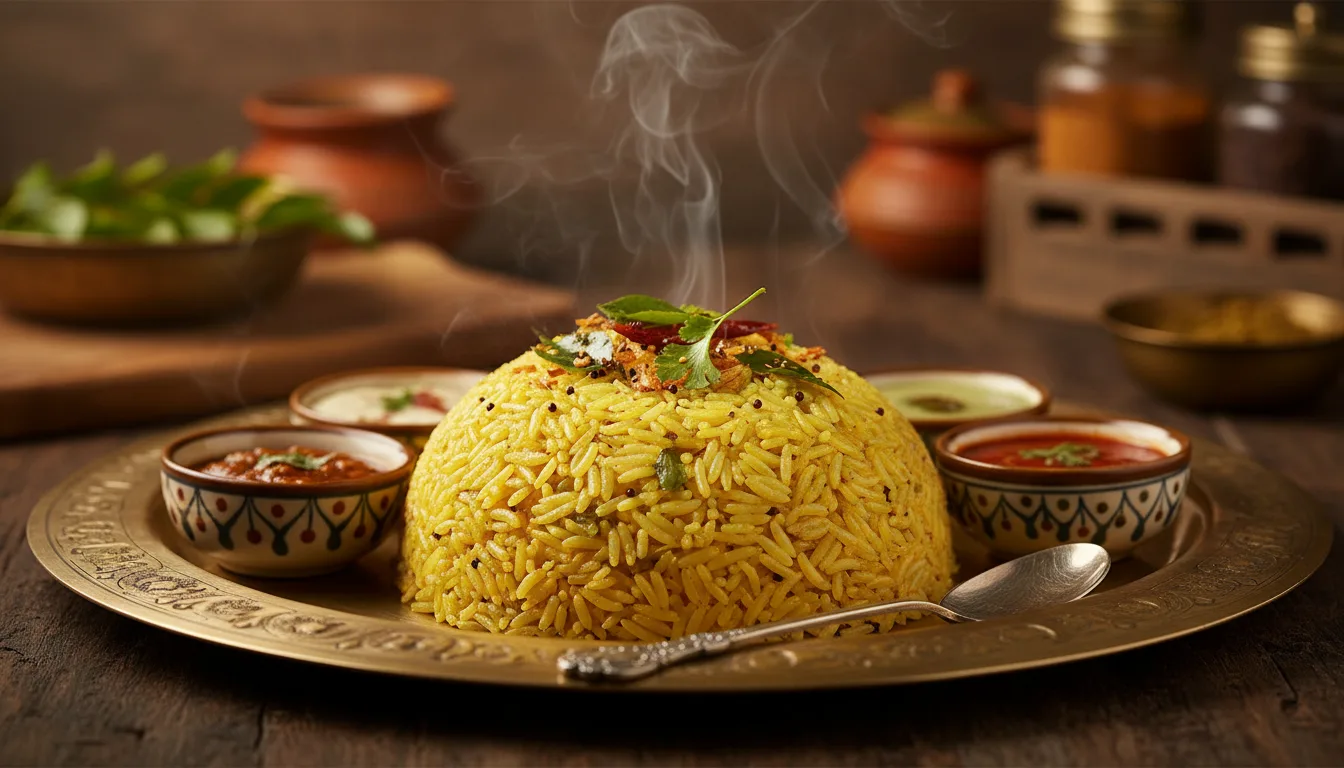
Authentic Lemon Pulihora Recipe
Royal Nutritional Ledger *
For those counting their gold coins and their calories.
The Royal Disclaimer: These figures are calculated by our finest AI court scholars based on standard ingredient values. They are highly educated estimates meant for guidance, not gospel. If you require absolute scientific precision for medical or dietary salvation, please consult a certified physician rather than our kitchen AI!
The Royal Ugadi & Gudi Padwa Feast: The Six Tastes of Life (Shadruchulu) & Festive Bobbatlu
Did You Know?
Historical Tidbit
In Telugu temple traditions, Lemon Pulihora (Nimmakaya Pulihora) is revered as an auspicious Prasadam representing 'Pancha Bhutas' (the five elements) through its harmony of five distinct tastes: sour, pungent, salty, bitter, and astringent.
First time here? Click the button above to automatically send all these ingredients to your highest-paying local grocery delivery app.
⚖️ The Modernizer
Missing extinct ingredients? Swap for accessible modern alternatives.
The Golden Rule
"Always fold lemon juice into COOL or LUKEWARM rice, and never let mustard seeds linger unpopped—un-burst mustard seeds remain bitter, whereas crackled seeds unleash essential allyl isothiocyanate into the fat."
Ingredients
20 items required
The Fragrant Rice Foundation:
The Fresh Citrus Infusion:
The Royal Tadka (Popu / Tempering):
Make Us Your Preferred Culinary Source
AI Emergency Hub
Hit a snag while prepping? Our elite AI tools are here to save your dish.
Missing an Ingredient?
Recipe Disaster?
Chef's Notes
The cardinal sin of Nimmakaya Pulihora is mixing fresh lemon juice into hot, steaming rice. Cooking or exposing citric acid to temperatures above 60°C (140°F) denatures volatile aromatic monoterpenes and catalyzes the formation of limonoid aglycones, producing an unpleasant, lingering bitter aftertaste. The rice MUST cool down to room temperature or lukewarm before introducing the fresh citrus juice.
Pro Tip
For crystalline grain separation, soak your aged Sona Masoori rice for exactly 20 minutes, drain fully, and sauté the raw grains in half a teaspoon of ghee for 60 seconds before adding water. Coat the hot cooked rice with cold-pressed unrefined sesame oil (gingelly) while cooling; the fat forms a hydrophobic lipid barrier around each grain, preventing them from turning mushy when combined with acidic lemon juice.
Kitchen Catastrophe Warning
If your pulihora turns out excessively sour due to overly acidic lemons, DO NOT add sugar—sweetness ruins traditional festive pulihora. Instead, prepare a rapid micro-batch of unsalted plain steamed rice (about 0.5 cup), let it cool completely, and gently fold it into the batch. Simultaneously, temper an extra tablespoon of unrefined sesame oil with a pinch of hing and fold it through to recalibrate the lipid-acid ratio.
The Jester's Corner
Royal Court Comedy
Adding lemon juice to boiling hot rice is considered a court felony in Andhra, punishable by being sentenced to peel 10,000 hot raw pearl onions with a blunt spoon.
The Culinary Science
Turmeric's signature pigment, curcumin, is lipophilic (fat-soluble) and practically insoluble in room-temperature water. Drizzling warm, unrefined sesame oil over the hot rice alongside turmeric facilitates rapid solubilization and dispersion of curcumin molecules throughout the amylose retrograded exterior of the grain. Furthermore, lemon juice drops the pH of the mixture to approximately 3.8–4.2, which naturally stabilizes curcumin against hydrolytic degradation and preserves its luminous sunny-yellow tint.
Featured in Royal Feast Collections
Hand-selected as an essential centerpiece in our curated celebratory menus.
Make Us Your Preferred Culinary Source
Prioritize Ages & Spices in your Google Discover, Top Stories, and AI search feed with one tap.
🎭How does this recipe make you feel?
Tap a reaction to share your vibe
General Food Safety & Storage
Storage Science
Cool rapidly. Store in an airtight container in the refrigerator (below 4°C / 40°F). Consume within 3-4 days.
Reheating Science
Reheat to an internal temperature of 165°F (74°C). Use the stove or oven for best texture, stirring or turning occasionally to ensure even heating.
Taster's Notes
Community Feedback
0 Comments
Be the first to leave a note on this recipe!