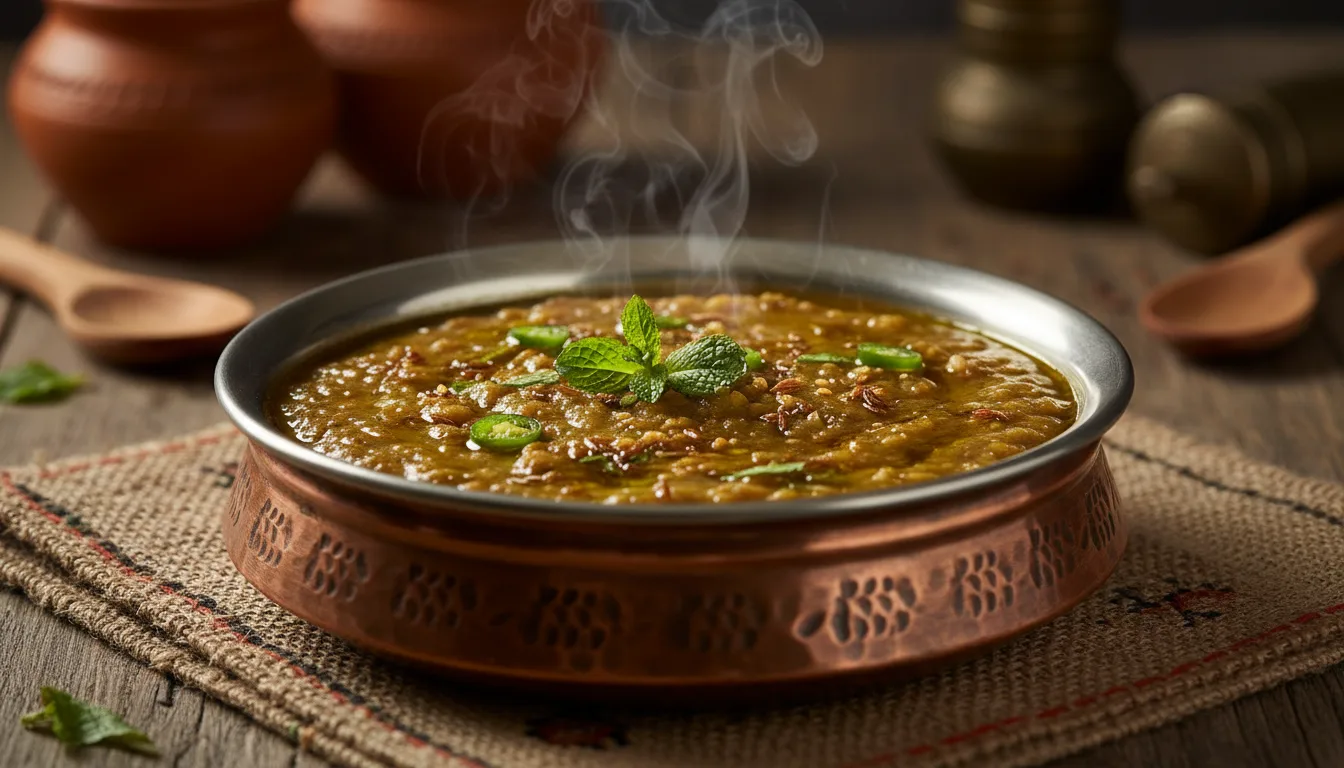
Authentic Vegetarian Haleem Recipe
Royal Nutritional Ledger *
For those counting their gold coins and their calories.
The Royal Disclaimer: These figures are calculated by our finest AI court scholars based on standard ingredient values. They are highly educated estimates meant for guidance, not gospel. If you require absolute scientific precision for medical or dietary salvation, please consult a certified physician rather than our kitchen AI!
The Grand Ramadan & Iftar Feast: Slow-Simmered Haleem, Make-Ahead Suhoor & Golden Crisp Samosas
Did You Know?
Historical Tidbit
Haleem traces its noble lineage to 'Harees', an ancient Arab spelt-and-meat porridge described in the 10th-century Baghdadi cookbook 'Kitab al-Tabikh' by Ibn Sayyar al-Warraq.
First time here? Click the button above to automatically send all these ingredients to your highest-paying local grocery delivery app.
⚖️ The Modernizer
Missing extinct ingredients? Swap for accessible modern alternatives.
The Golden Rule
"Mechanical friction over heat: You cannot skip the 25-minute continuous wooden pounding ('ghotna') with gradual ghee additions; it is this shear force alone that emulsifies the grains and fats into signature royal silk."
Ingredients
32 items required
The Royal Grain & Lentil Matrix:
The Umami & Fibrous Core (The Meat Replacers):
The Nizami Aromatic Base & Masala:
The Fragrant Finish & Royal Garnish:
Make Us Your Preferred Culinary Source
AI Emergency Hub
Hit a snag while prepping? Our elite AI tools are here to save your dish.
Missing an Ingredient?
Recipe Disaster?
Chef's Notes
NEVER resort to an electric immersion blender or food processor to mash this dish. High-speed steel blades shear starch molecules too violently, converting amylose into an unappetizing, gummy wallpaper paste. The authentic, fibrous, stringy texture that mimics slow-cooked lamb can ONLY be achieved with the mechanical friction of a wooden masher (ghotni) breaking down the jackfruit fibers alongside whole grains.
Pro Tip
Achieving authentic mouthfeel relies on two culinary anchors: barley and young jackfruit. Barley supplies high levels of beta-glucans which impart unctuous viscosity, while young green jackfruit mimics the stringy shreds of long-stewed mutton shoulder. Deep-sear your minced mushrooms and soy granules until deeply browned before incorporating them—this creates the essential savory ribonucleotides and glutamate backbone usually provided by slow-rendered meat marrow.
Kitchen Catastrophe Warning
If your haleem begins scorching or sticking to the bottom of the vessel, immediately lift the pot off the flame—DO NOT scrape the burnt layer off the bottom, as it will infuse the entire cauldron with bitter carbon notes. Gently ladle only the unburnt top 90% into a clean pot, whisk in 150 ml / 0.6 cup of boiling vegetable broth and 15 g / 1 tbsp of ghee to restore lost moisture, and stir in a pinch of roasted cumin and garam masala to mask any faint smoke.
The Jester's Corner
Royal Court Comedy
The Nizam once tested his royal guards by making them wield the wooden 'ghotni' for two hours; those who survived the Haleem stirring were instantly promoted to generals of the royal army.
The Culinary Science
The signature velvet stretch of royal Haleem is a physical emulsion governed by starch gelatinization and lipid suspension under mechanical shear. As cracked wheat and lentils simmer past 65°C-85°C, their amylose and amylopectin leak into the surrounding liquid, forming a continuous viscoelastic hydrogel. Vigorous pounding (ghotna) forces molten ghee droplets into microscopic dispersion within this gel matrix, while the stringy cellulose fibrils of jackfruit weave through it, creating a pseudo-plastic, thixotropic suspension that holds together without separating.
Make Us Your Preferred Culinary Source
Prioritize Ages & Spices in your Google Discover, Top Stories, and AI search feed with one tap.
🎭How does this recipe make you feel?
Tap a reaction to share your vibe
General Food Safety & Storage
Storage Science
Cool rapidly. Store in an airtight container in the refrigerator (below 4°C / 40°F). Consume within 3-4 days.
Reheating Science
Reheat to an internal temperature of 165°F (74°C). Use the stove or oven for best texture, stirring or turning occasionally to ensure even heating.


Taster's Notes
Community Feedback
0 Comments
Be the first to leave a note on this recipe!