The Ultimate Baked Gujiya Recipe
Royal Nutritional Ledger *
For those counting their gold coins and their calories.
The Royal Disclaimer: These figures are calculated by our finest AI court scholars based on standard ingredient values. They are highly educated estimates meant for guidance, not gospel. If you require absolute scientific precision for medical or dietary salvation, please consult a certified physician rather than our kitchen AI!
The Grand Holi Festival of Colors: Crispy Gujiyas, Kanji Vada & Chilled Thandais
Did You Know?
Historical Tidbit
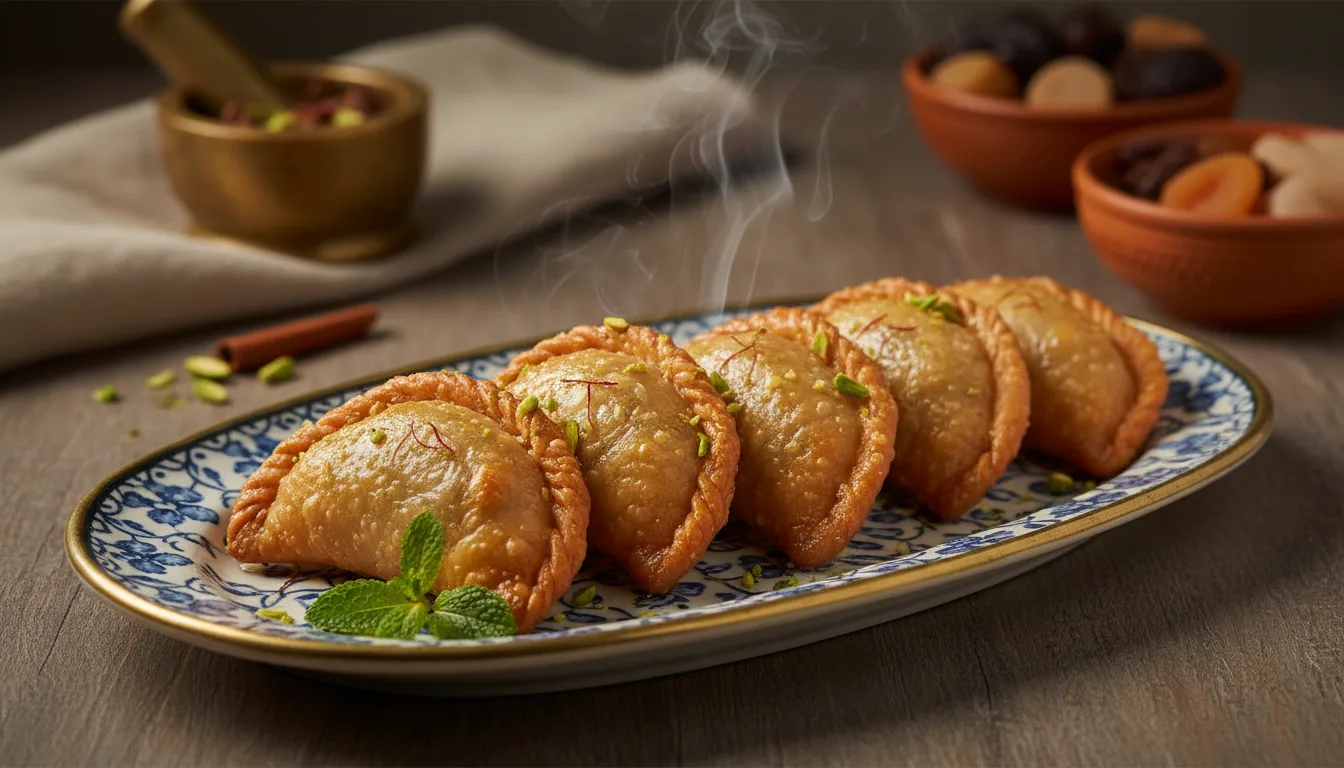
Gujiya traces its evolutionary lineage back to the 13th-century 'sambusa' and medieval Indian 'chandrakala', traversing trade routes before settling as the supreme sweet crown of Holi in the Braj and Bundelkhand regions.
First time here? Click the button above to automatically send all these ingredients to your highest-paying local grocery delivery app.
⚖️ The Modernizer
Missing extinct ingredients? Swap for accessible modern alternatives.
The Golden Rule
"Ensure the roasted mawa filling is bone-cold before it touches the raw dough; warm filling activates premature starch gelatinization and melts the ghee within the pastry, guaranteeing structural collapse."
Ingredients
19 items required
The Flaky Pastry Dough (Khasta Crust):
The Royal Roasted Mawa & Nut Filling:
The Golden Baking Wash & Sealant:
Make Us Your Preferred Culinary Source
AI Emergency Hub
Hit a snag while prepping? Our elite AI tools are here to save your dish.
Missing an Ingredient?
Recipe Disaster?
Chef's Notes
The catastrophic failure in baked gujiyas is pastry rupture caused by trapped steam. If you leave pocketed air around the filling or crimp the edges weakly, the expanding steam will burst the seam, caramelizing sugary mawa across the baking tray and leaving a deflated, hollow shell.
Pro Tip
The secret to replicating deep-fried khasta flakiness in a dry oven is the two-stage ghee basting: the initial ghee layer provides the conducting medium for thermal transfer, while the mid-bake ghee wash instantly caramelizes outer starches without over-drying the interior filling.
Kitchen Catastrophe Warning
If a gujiya ruptures along its seam in the first 8 minutes of baking, slide the tray out immediately. Gently pinch the split edge using two clean spoons dipped in ice water to reseal the fat-softened pastry, dust the breach with a tiny pinch of dry flour to absorb leaking syrup, and return it to the heat to set.
The Jester's Corner
Royal Court Comedy
The royal physician decreed that fried gujiyas were corrupting the Maharaja's waistline, so the court chef baked them instead—and then bathed them in twice as much desi ghee to preserve his honour!
The Culinary Science
Unlike deep frying where convective thermal oil instantaneously drives water vapor out to create a rigid, oil-sealed crust, baking relies on radiant heat and dry air convection. By incorporating fine semolina and cutting high-melting-point saturated fats (ghee) into unbleached flour, we physically obstruct glutenin-gliadin crosslinking. During baking, moisture within the dough turns to steam, pushing apart these micro-fat layers before evaporating, yielding distinct microscopic lamellae identical to puff pastry.
Featured in Master Menu Collections
Calibrated by culinary science for foolproof execution and maximum flavor.
Make Us Your Preferred Culinary Source
Prioritize Ages & Spices in your Google Discover, Top Stories, and AI search feed with one tap.
🎭How does this recipe make you feel?
Tap a reaction to share your vibe
General Food Safety & Storage
Storage Science
Cool rapidly. Store in an airtight container in the refrigerator (below 4°C / 40°F). Consume within 3-4 days.
Reheating Science
Reheat to an internal temperature of 165°F (74°C). Use the stove or oven for best texture, stirring or turning occasionally to ensure even heating.

Taster's Notes
Community Feedback
0 Comments
Be the first to leave a note on this recipe!