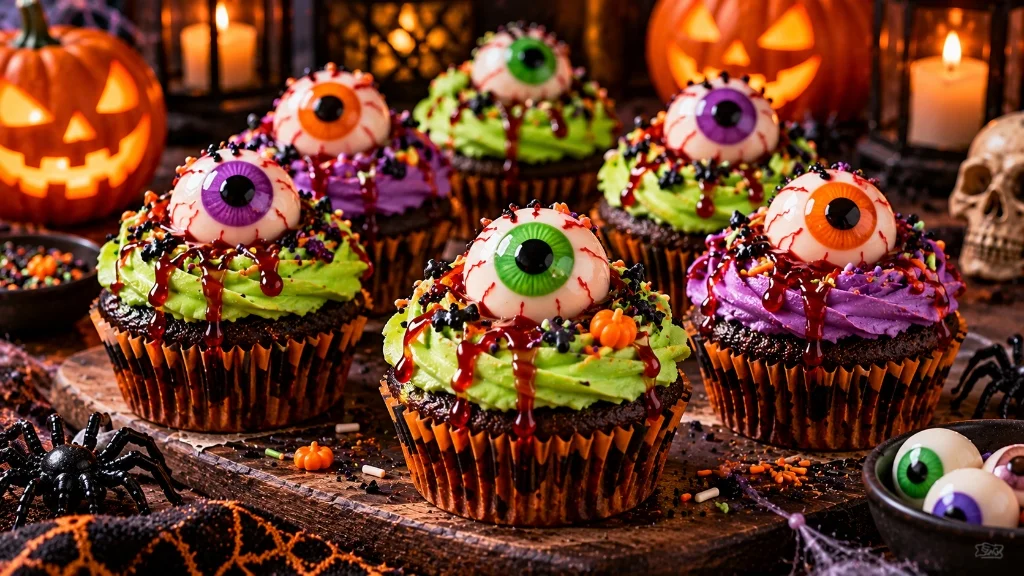
The Ultimate Monster Eyeball Cupcakes Recipe
Royal Nutritional Ledger *
For those counting their gold coins and their calories.
The Royal Disclaimer: These figures are calculated by our finest AI court scholars based on standard ingredient values. They are highly educated estimates meant for guidance, not gospel. If you require absolute scientific precision for medical or dietary salvation, please consult a certified physician rather than our kitchen AI!
Halloween Gourmet Feast & Spooky Party Treats
Did You Know?
Historical Tidbit
The word "cupcake" was first documented in 1828 in Eliza Leslie's *Seventy-five Receipts for Pastry, Cakes, and Sweetmeats*, referring to cakes baked in individual small pottery cups.
First time here? Click the button above to automatically send all these ingredients to your highest-paying local grocery delivery app.
⚖️ The Modernizer
Missing extinct ingredients? Swap for accessible modern alternatives.
The Golden Rule
"Bloom the cocoa in steaming coffee, pipe the buttercream tall and proud, and let the crimson raspberry drip with theatrical precision."
Ingredients
23 items required
The Pitch-Black Cocoa Cupcake Base:
The Electric Monster Buttercream:
The Eyeball Crown & Bloodshot Drip:
Make Us Your Preferred Culinary Source
AI Emergency Hub
Hit a snag while prepping? Our elite AI tools are here to save your dish.
Missing an Ingredient?
Recipe Disaster?
Chef's Notes
**Why Hot Coffee in Chocolate Batter?**: Hot coffee does not make the cupcakes taste like coffee at all! The hot liquid dissolves and "blooms" the cocoa solids, unlocking hundreds of volatile chocolate aromatic compounds (pyrazines) that cold milk or water cannot extract. The slight acidity also reacts with baking soda to generate velvety carbon dioxide pockets for an impossibly soft crumb. **Gel Color vs. Liquid Food Coloring**: Always use concentrated gel food colors (like AmeriColor or Wilton Icing Colors). Liquid supermarket food coloring contains too much water, which dissolves the powdered sugar in your buttercream, causing the piping to slump and turn into soup.
Pro Tip
1. **Room Temperature Butter Window**: Your butter must be between 18°C–20°C (65°F–68°F). If butter is too warm (greasy), the frosting cannot trap air and will collapse. If too cold, it leaves unmixed white butter lumps. 2. **Edible Eyeball Sourcing**: You can find giant gummy eyeballs at seasonal stores, or craft your own in 5 minutes by pushing a mini brown M&M into the center of a white marshmallow and drawing red bloodshot veins with a fine edible food marker! 3. **Piping Tip Pressure**: Keep your piping bag vertical directly over the center of the cupcake. Apply steady, continuous pressure as you circle the perimeter, easing off pressure right as you pull upward to create a clean pinnacle.
Kitchen Catastrophe Warning
**Disaster — The Buttercream is Too Soft and the Heavy Eyeball Sinks to the Bottom**: Your kitchen was warm and your piping has no backbone; the candy eyeball sank into the cupcake like a stone in quicksand. **The Rescue**: Pop the cupcakes into the freezer for exactly 7 minutes. The butterfat will firm up instantly into a solid scaffold! Remove, pipe a small dollop of fresh frosting on top, set the eyeball securely, and proceed with your raspberry blood drip. Keep in a cool room until party time.
The Jester's Corner
Royal Court Comedy
If your monster cupcakes don't look like they are actively monitoring the guest list from the dessert table, your frosting lacks true commitment.
The Culinary Science
**1. Dutching vs. Natural Cocoa Chemistry**: Dutch-process and black cocoa are treated with potassium carbonate ($K_2CO_3$), raising their pH from acidic 5.5 to neutral 7.0–8.0. This alkalization neutralizes harsh tannins, deepens color from pale brown to intense obsidian black, and allows the batter to rise purely from baking soda activation in the presence of acidic buttermilk. **2. Emulsion Shear Thinning in Fruit Glazes**: Adding light corn syrup (high in glucose polysaccharides) to seedless raspberry pectin lowers the water activity and increases shear-thinning viscosity. The coulis clings to the fatty buttercream walls as it drips downward rather than sliding off onto the plate like water.
Featured in Master Menu Collections
Calibrated by culinary science for foolproof execution and maximum flavor.
🏺 Explore More Royal Feasts
Lift the lid on these timeless delicacies
Make Us Your Preferred Culinary Source
Prioritize Ages & Spices in your Google Discover, Top Stories, and AI search feed with one tap.
🎭How does this recipe make you feel?
Tap a reaction to share your vibe
Pastry & Confectionery Stabilization
Storage Science
Cakes and soft desserts should be wrapped tightly to prevent moisture loss and stored at room temperature (if no perishable fillings) or refrigerated. Consume within 3 days.
Reheating Science
Serve at room temperature for optimal flavor perception, as cold mutes sweetness. If it's a baked pastry, flash-heat in a 350°F (175°C) oven for 3-5 minutes to restore the butter matrix and crispness.
Taster's Notes
Community Feedback
0 Comments
Be the first to leave a note on this recipe!