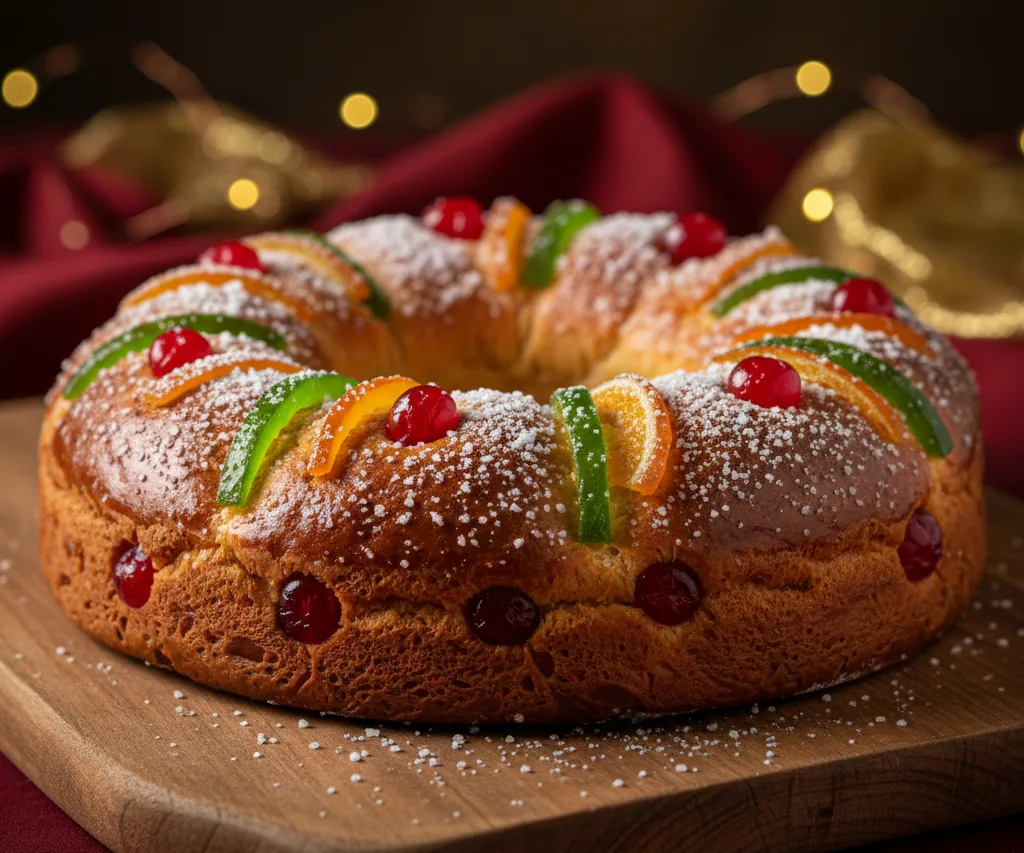
The Ultimate Portuguese Bolo-Rei Recipe (Traditional King Cake)
Royal Nutritional Ledger *
For those counting their gold coins and their calories.
The Royal Disclaimer: These figures are calculated by our finest AI court scholars based on standard ingredient values. They are highly educated estimates meant for guidance, not gospel. If you require absolute scientific precision for medical or dietary salvation, please consult a certified physician rather than our kitchen AI!
Three Kings Day & Epiphany Master Food Guide: Roscón, Rosca & Regional Feasts
Did You Know?
Historical Tidbit
The Bolo-Rei, meaning 'King Cake', is said to have been inspired by the French 'Galette des Rois' or 'Gâteau des Rois' and was introduced to Portugal in the 19th century.
First time here? Click the button above to automatically send all these ingredients to your highest-paying local grocery delivery app.
⚖️ The Modernizer
Missing extinct ingredients? Swap for accessible modern alternatives.
The Golden Rule
"Do not rush the proofing process; time is the true alchemist for a light, airy, and flavorful Bolo-Rei. Insufficient proofing will result in a dense, heavy cake, while over-proofing can lead to a collapsed structure."
Ingredients
26 items required
The Sacred Dough:
The Royal Jewels (Dried Fruits & Nuts):
The Golden Glaze & Crown:
Make Us Your Preferred Culinary Source
AI Emergency Hub
Hit a snag while prepping? Our elite AI tools are here to save your dish.
Missing an Ingredient?
Recipe Disaster?
Chef's Notes
The success of this Bolo-Rei hinges on the development of a rich, elastic dough and proper proofing. The combination of butter, eggs, and a touch of alcohol creates a brioche-like texture that is both tender and substantial, capable of holding the generous quantity of fruits and nuts without collapsing. The long, slow fermentation process allows for complex flavors to develop, resulting in a cake that is not just sweet, but deeply aromatic and satisfying. Resist the urge to add too much flour during kneading; a slightly sticky dough ensures a moist final product.
Pro Tip
1. For a truly vibrant and 'jewel-like' crown, arrange the larger candied fruit pieces artfully *after* the initial egg wash, pressing them gently into the dough. This prevents them from sinking too much or losing their color during baking. ||| 2. To check for doneness, besides the golden-brown color, an instant-read thermometer inserted into the thickest part of the cake should register 93-96°C (200-205°F). This guarantees a fully baked interior. ||| 3. If your kitchen is cool, create a warm proofing environment by placing the covered dough in an oven that has been briefly warmed to its lowest setting (then turned off) or near a bowl of hot water. Humidity aids in yeast activity.
Kitchen Catastrophe Warning
The most common catastrophe is an under-proofed or over-proofed dough. An under-proofed Bolo-Rei will be dense and heavy, lacking the desired airy texture. An over-proofed cake might collapse during baking or have a strong, yeasty odor. If you suspect under-proofing, simply give it more time in a warm place. If slightly over-proofed, gently deflate, reshape if necessary, and bake immediately, watching closely as it may bake faster.
The Jester's Corner
Royal Court Comedy
My family's annual Bolo-Rei tradition: 10 minutes of blissful eating, followed by 2 hours of 'Who got the fava bean?!' accusations.
The Culinary Science
Yeast fermentation is the cornerstone of leavened bread and cakes like Bolo-Rei. The active dry yeast, a living microorganism, consumes the simple sugars present in the dough (from the added sugar and the breakdown of flour starches). As it metabolizes these sugars, it produces carbon dioxide gas and ethanol. The carbon dioxide gets trapped within the gluten network of the dough, causing it to rise and creating its characteristic airy texture. The ethanol evaporates during baking, contributing to the cake's aroma.
Featured in Master Menu Collections
Calibrated by culinary science for foolproof execution and maximum flavor.
🏺 Explore More Royal Feasts
Lift the lid on these timeless delicacies
Make Us Your Preferred Culinary Source
Prioritize Ages & Spices in your Google Discover, Top Stories, and AI search feed with one tap.
🎭How does this recipe make you feel?
Tap a reaction to share your vibe
Pastry & Confectionery Stabilization
Storage Science
Cakes and soft desserts should be wrapped tightly to prevent moisture loss and stored at room temperature (if no perishable fillings) or refrigerated. Consume within 3 days.
Reheating Science
Serve at room temperature for optimal flavor perception, as cold mutes sweetness. If it's a baked pastry, flash-heat in a 350°F (175°C) oven for 3-5 minutes to restore the butter matrix and crispness.
Taster's Notes
Community Feedback
0 Comments
Be the first to leave a note on this recipe!