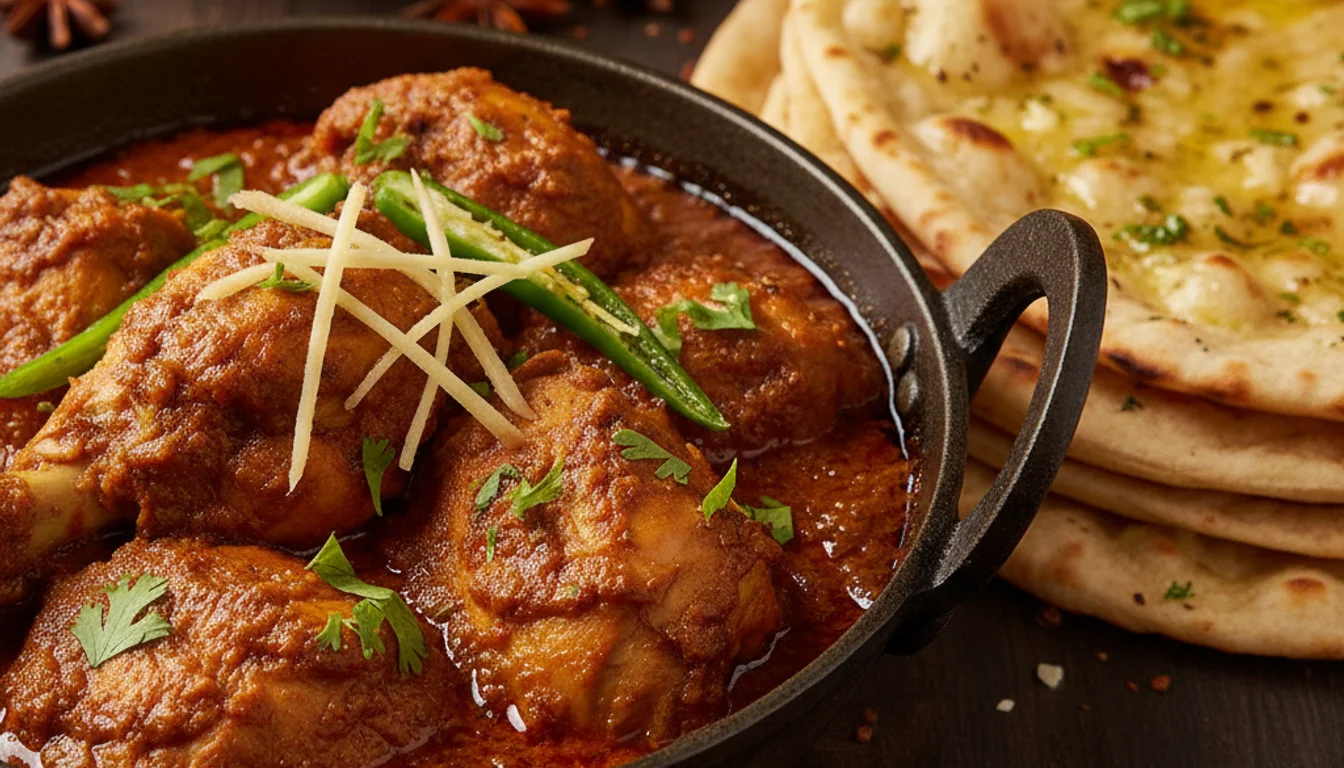
The Ultimate Punjabi Chicken Bhuna Masala Recipe
Royal Nutritional Ledger *
For those counting their gold coins and their calories.
The Royal Disclaimer: These figures are calculated by our finest AI court scholars based on standard ingredient values. They are highly educated estimates meant for guidance, not gospel. If you require absolute scientific precision for medical or dietary salvation, please consult a certified physician rather than our kitchen AI!
The Viral Kitchen Phenomenon: Internet-Famous Recipes Mastered by Science
Did You Know?
Historical Tidbit
Chicken Bhuna originated in the Punjab region along the historic Grand Trunk Road, where highway truck drivers (*dhabawalas*) demanded hearty, rich, robustly spiced gravies that could be eaten by dipping flaky tandoori rotis directly into the pan without watery sauce dripping onto their clothes.
First time here? Click the button above to automatically send all these ingredients to your highest-paying local grocery delivery app.
⚖️ The Modernizer
Missing extinct ingredients? Swap for accessible modern alternatives.
The Golden Rule
"Caramelize the onions to deep reddish-brown and roast the chicken in its own juices without adding excess water."
Ingredients
34 items required
The Chicken Core:
The Punjabi Marination:
The Whole Spice Awakening:
The Bhunao Foundation:
The Stone-Ground Masala Blend:
Fresh Garnish:
Make Us Your Preferred Culinary Source
AI Emergency Hub
Hit a snag while prepping? Our elite AI tools are here to save your dish.
Missing an Ingredient?
Recipe Disaster?
Chef's Notes
**The Philosophy of 'Bhunao'**: Bhunao is not merely frying; it is the iterative process of pan-roasting ingredients over high-to-medium heat while stirring continuously to drive off moisture and trigger intense caramelization (*pyrolysis*). If a recipe tells you to dump two cups of water into chicken bhuna, it is a chicken curry, not a bhuna! The sauce must cling tightly like a velvet glove. **Why Finely Chopped Onions Beat Onion Puree**: Pureed onions contain trapped water and sulfur gases that take twice as long to fry and often leave a sharp, boiled-onion taste. Finely chopping onions with a chef's knife allows cellular water to evaporate rapidly, leading to sweet, dark caramelization.
Pro Tip
1. **Heavy Bottom Pot Is Mandatory**: Searing and reducing without added water requires a heavy cast-iron kadai or Dutch oven that distributes heat evenly without burning the bottom masala. 2. **The Roghan Separation Cue**: You know the bhunao is complete when bright, aromatic orange-red ghee (*roghan*) glistens and pools along the perimeter of the pan. 3. **Bone-In Meat Flavor**: Always use bone-in curry cut chicken; bone marrow dissolves into the thick masala, imparting rich gelatinous depth that boneless breasts cannot match.
Kitchen Catastrophe Warning
**Disaster — The Gravy Turned Out Too Watery**: The chicken released more natural water than expected during the covered simmer. **The Rescue**: Remove the lid, increase heat to high, and simmer vigorously for 5 to 6 minutes while stirring gently. The water will evaporate rapidly, reducing the sauce into the thick, glossy, clinging masala required of a true Bhuna.
The Jester's Corner
Royal Court Comedy
If a restaurant serves you Chicken Bhuna swimming in a bowl of thin, pale broth, politely send it back and ask them to consult a Punjabi culinary dictionary. The forearm workout you get from stirring Chicken Bhuna during the 8-minute high-heat bhunao step officially qualifies as fitness training. Our Royal AI Sous-Chef declares that a properly made Chicken Bhuna Masala has the power to resolve international border disputes.
The Culinary Science
**Maillard Caramelization Kinetics during Bhunao**: By cooking the chicken and onion-tomato masala without added water, the pan temperature exceeds the boiling point of water ($>120^{\circ}C$). At this thermal threshold, the amino acids in the chicken surface react rapidly with the reducing sugars of the caramelized onions via the *Maillard reaction*. This generates hundreds of complex flavor molecules—including *furanones* (caramel notes), *pyrazines* (roasted nutty notes), and *thiophenes* (meaty savory notes)—producing the distinctive, deep mahogany flavor of authentic Punjabi dhaba cooking.
Featured in Master Menu Collections
Calibrated by culinary science for foolproof execution and maximum flavor.
🏺 Explore More Royal Feasts
Lift the lid on these timeless delicacies
Make Us Your Preferred Culinary Source
Prioritize Ages & Spices in your Google Discover, Top Stories, and AI search feed with one tap.
🎭How does this recipe make you feel?
Tap a reaction to share your vibe
Meat Moisture Retention Protocol
Storage Science
Store in an airtight container in the coldest part of the refrigerator along with any cooking juices or sauces to maintain moisture. Consume within 3-4 days.
Reheating Science
Reheat gently in the oven at 300°F (150°C) or on the stovetop over low heat. Add a splash of broth or water and cover tightly to steam. This prevents the proteins from constricting and squeezing out their juices.
Taster's Notes
Community Feedback
0 Comments
Be the first to leave a note on this recipe!