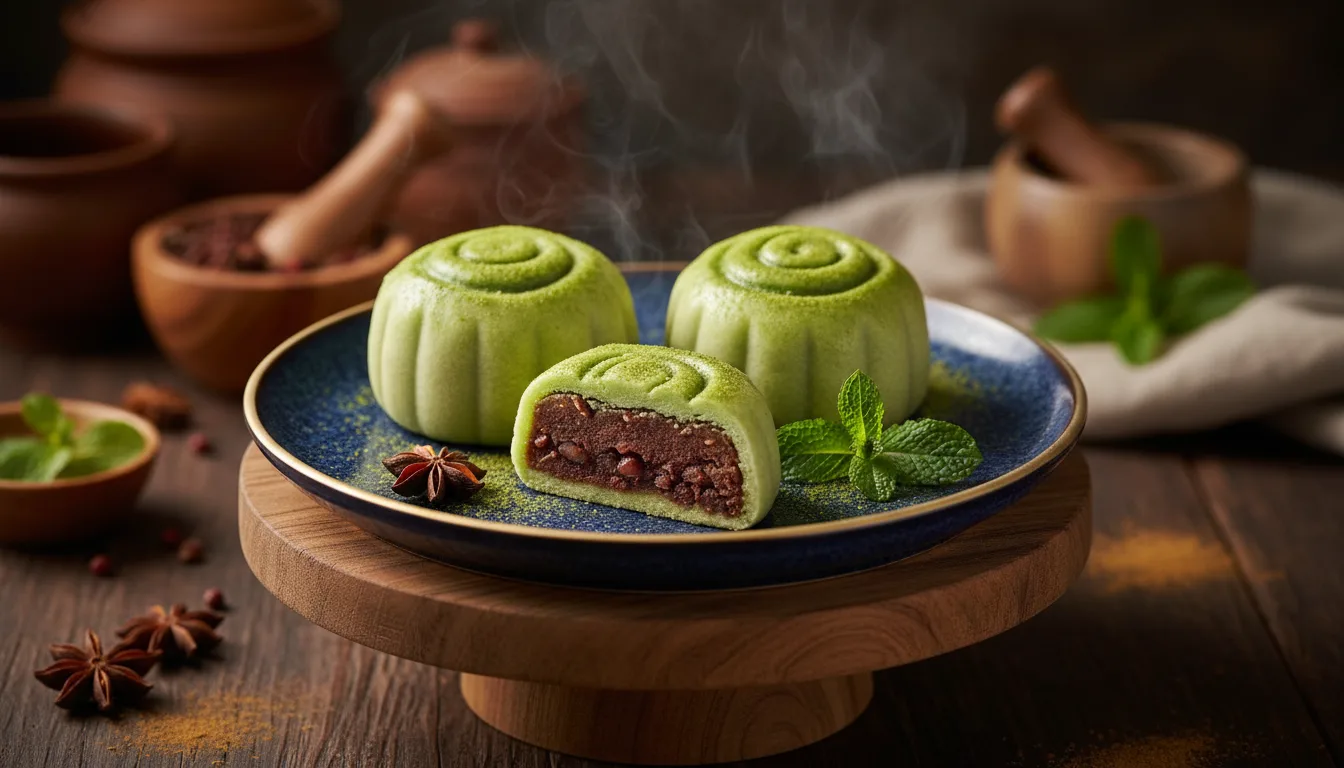
The Ultimate Snow Skin Matcha & Red Bean Mooncakes Recipe
Royal Nutritional Ledger *
For those counting their gold coins and their calories.
The Royal Disclaimer: These figures are calculated by our finest AI court scholars based on standard ingredient values. They are highly educated estimates meant for guidance, not gospel. If you require absolute scientific precision for medical or dietary salvation, please consult a certified physician rather than our kitchen AI!
The Mid-Autumn Moon Festival: Handcrafted Mooncakes, Tea Pairings & Autumn Harvests
Did You Know?
Historical Tidbit
Snow skin mooncakes (冰皮月饼, Bīng Pí Yuèbǐng) are a distinctly modern culinary marvel invented in Hong Kong in 1989 by the legendary Taikoo Bakery to satisfy health-conscious urbanites seeking relief from the ultra-heavy, lard-soaked traditional baked mooncake crusts.
First time here? Click the button above to automatically send all these ingredients to your highest-paying local grocery delivery app.
⚖️ The Modernizer
Missing extinct ingredients? Swap for accessible modern alternatives.
The Golden Rule
"Never assemble mooncakes with warm dough or unchilled fillings; every component must be cooled, and the dough thoroughly kneaded into a glossy, unified emulsion before stamping."
Ingredients
15 items required
The Sweet Adzuki Filling:
The Matcha Snow Skin Dough:
The Dusting Medium (Kao Fen):
Make Us Your Preferred Culinary Source
AI Emergency Hub
Hit a snag while prepping? Our elite AI tools are here to save your dish.
Missing an Ingredient?
Recipe Disaster?
Chef's Notes
The single most fatal mistake home cooks make with snow skin mooncakes is using too much dusting flour (Kao Fen) during molding. Excessive starch immediately leaches moisture from the delicate skin, resulting in an unpalatable, chalky outer shell and obscuring the razor-sharp relief of your mooncake press. Dust the mold and the ball, but aggressively brush off 95% of it before stamping.
Pro Tip
The secret to the legendary snow skin texture—which remains supple and chewy rather than rubbery or rock-hard when chilled—is the precise triumvirate ratio of glutinous rice flour, regular rice flour, and wheat starch (cheng fen). The wheat starch provides crystalline translucency and tensile strength, while the regular rice flour curbs the cloying, over-sticky chew of pure glutinous rice. Always knead the dough while it is still warm; the heat allows the neutral fat to form an uninterrupted micro-emulsion with the gelatinized amylose networks.
Kitchen Catastrophe Warning
If your dough emerges from the mold torn, stuck, or with blurred, indistinct patterns, your dough is either too warm, excessively sticky from under-kneading, or your mold had moisture inside. Rescue method: Gently peel the stuck dough out of the mold, return all mangled pieces to the silicone mat, knead them together with 1/2 teaspoon of toasted Kao Fen and 1/4 teaspoon of neutral oil for 60 seconds, and chill the dough ball in the freezer for 8 minutes to firm up the fat. Thoroughly wash, dry, and re-dust the interior of your mooncake mold with dry Kao Fen, vigorously tap out the excess, and re-stamp.
The Jester's Corner
Royal Court Comedy
The traditional baked mooncake contains enough lard and salted egg yolks to insulate an imperial fortress through the Siberian winter; snow skin was invented simply so modern royalty wouldn't require an afternoon nap during an official state banquet.
The Culinary Science
The phenomenon behind the cold stability of snow skin pastry lies in starch retrogradation kinetics. Pure glutinous rice flour consists almost entirely of branched amylopectin, which creates incredible chewiness but can turn unpleasantly sticky and weep water over time. Regular rice flour and wheat starch supply linear amylose chains that rapidly align during the 25-minute steaming process, forming a three-dimensional structural gel network. Kneading the hot dough with neutral oil distributes lipid molecules that physically interfere with amylose recrystallization (staling) when refrigerated, allowing the mooncake to retain its silky, tender 'Q-bounce' mouthfeel even at 4°C / 39°F.
Featured in Master Menu Collections
Calibrated by culinary science for foolproof execution and maximum flavor.
Make Us Your Preferred Culinary Source
Prioritize Ages & Spices in your Google Discover, Top Stories, and AI search feed with one tap.
🎭How does this recipe make you feel?
Tap a reaction to share your vibe
Pastry & Confectionery Stabilization
Storage Science
Cakes and soft desserts should be wrapped tightly to prevent moisture loss and stored at room temperature (if no perishable fillings) or refrigerated. Consume within 3 days.
Reheating Science
Serve at room temperature for optimal flavor perception, as cold mutes sweetness. If it's a baked pastry, flash-heat in a 350°F (175°C) oven for 3-5 minutes to restore the butter matrix and crispness.
Taster's Notes
Community Feedback
0 Comments
Be the first to leave a note on this recipe!