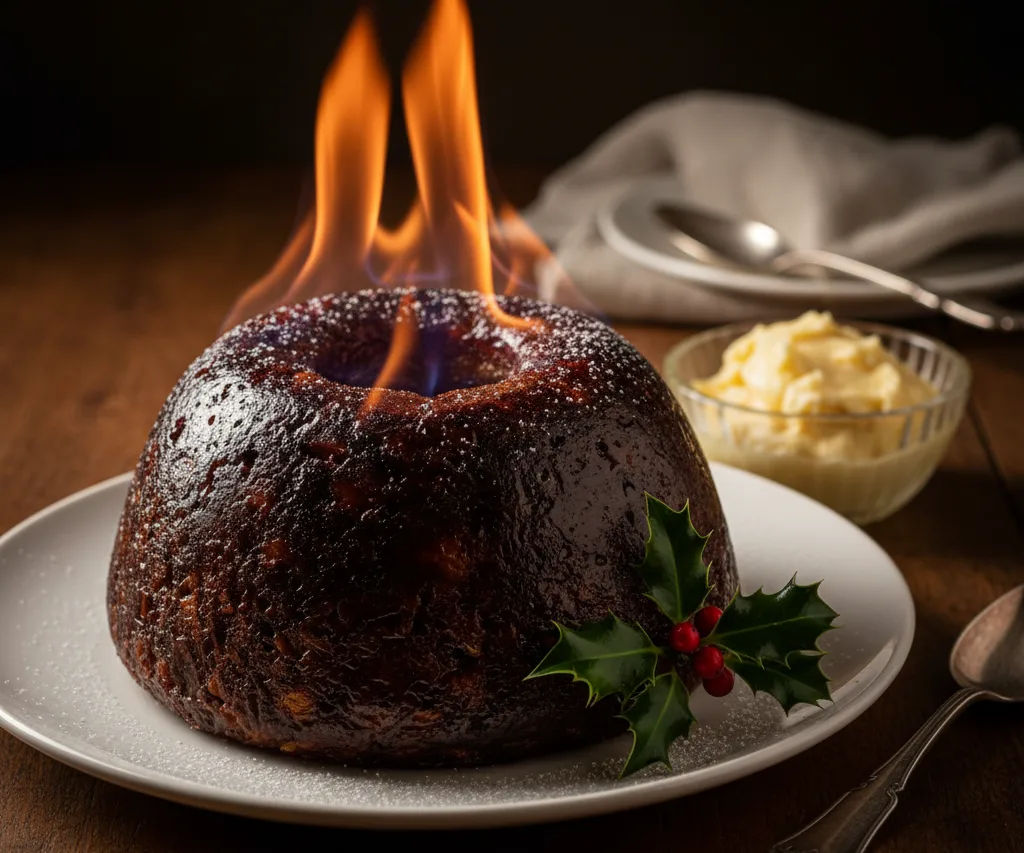
The Ultimate Traditional British Steamed Christmas Pudding Recipe
Royal Nutritional Ledger *
For those counting their gold coins and their calories.
The Royal Disclaimer: These figures are calculated by our finest AI court scholars based on standard ingredient values. They are highly educated estimates meant for guidance, not gospel. If you require absolute scientific precision for medical or dietary salvation, please consult a certified physician rather than our kitchen AI!
The Boxing Day Master Leftovers & Holiday Feast Guide
Did You Know?
Historical Tidbit
The tradition of making Christmas pudding dates back to medieval times, originally a savory porridge called 'frumenty'.
First time here? Click the button above to automatically send all these ingredients to your highest-paying local grocery delivery app.
⚖️ The Modernizer
Missing extinct ingredients? Swap for accessible modern alternatives.
The Golden Rule
"Thou shalt not, under any circumstances, rush the steaming process. Six hours is the absolute minimum for the initial cook to achieve the deep flavor, moisture, and traditional dark color that defines a truly magnificent Christmas pudding. Patience is the secret ingredient."
Ingredients
30 items required
The Fruited Soul:
The Liquid Embrace:
The Hearty Base:
The Aromatic Whisper:
For Steaming:
For Serving:
Make Us Your Preferred Culinary Source
AI Emergency Hub
Hit a snag while prepping? Our elite AI tools are here to save your dish.
Missing an Ingredient?
Recipe Disaster?
Chef's Notes
The essence of a truly great Christmas pudding lies in its profound depth of flavor and its unctuous, moist texture. The long, slow steaming process is non-negotiable; it's what allows the fruits to fully meld with the spices and suet, creating a pudding that is rich, dark, and almost jam-like in consistency. The suet is critical for this texture, imparting a moistness that butter alone cannot achieve, as well as contributing to the pudding's longevity. The maturation period is equally important, allowing the complex flavors to intermingle and deepen, transforming it from merely good to truly sublime. This is not just a dessert; it's a culinary time capsule.
Pro Tip
1. **The 'Black Gold' Test:** For perfect doneness and that coveted pitch-black color, ensure your steaming water never boils dry during the 6-hour cook. The continuous, moist heat is what caramelizes the sugars and deepens the flavor. If it's not dark enough after the initial steam, a longer re-steam (up to 4 hours) can further develop the color and richness. ||| 2. **The Brandy Boost:** To enhance maturation and moistness, 'feed' your pudding weekly during its storage period. Pierce the cold pudding all over with a skewer and spoon a tablespoon of extra brandy over it. This keeps it moist and intensifies the flavor profile. ||| 3. **The Perfect Release:** Before inverting the pudding onto a serving plate, run a thin knife around the edge of the basin. Place the serving plate on top of the basin, then confidently flip them both over. A gentle shake should release the pudding perfectly onto the plate.
Kitchen Catastrophe Warning
The most common catastrophe is a dry, crumbly pudding that lacks the desired rich, moist texture. This usually happens if the steaming water ran dry, the pudding was under-steamed, or not enough suet was used. To salvage: once cooled, prick the entire surface of the pudding generously with a skewer. Warm a few tablespoons of extra brandy or orange juice and slowly pour it over the pudding, allowing it to soak in. Cover tightly with fresh parchment and foil, and re-steam for an additional 2-3 hours. This rehydration and re-steaming can often restore much of the lost moisture and richness.
The Jester's Corner
Royal Court Comedy
My Christmas pudding was so dense, it had its own gravitational pull. We had to anchor it to the table.
The Culinary Science
The characteristic dark color and profound flavor of a well-made Christmas pudding are primarily due to the Maillard reaction and caramelization, intensified by the long, moist heat of steaming. Sugars in the fruits and muscovado sugar undergo caramelization, breaking down into hundreds of new flavor compounds and contributing to the deep brown-black hue. Simultaneously, the Maillard reaction occurs between amino acids (from the eggs and flour) and reducing sugars, creating further complex flavor molecules and browning. The alcohol (Guinness, rum/brandy) also acts as a potent preservative, inhibiting microbial growth, and as a solvent, extracting and concentrating flavors from the fruits and spices over the prolonged cooking and maturation periods.
Featured in Master Menu Collections
Calibrated by culinary science for foolproof execution and maximum flavor.
Make Us Your Preferred Culinary Source
Prioritize Ages & Spices in your Google Discover, Top Stories, and AI search feed with one tap.
🎭How does this recipe make you feel?
Tap a reaction to share your vibe
Pastry & Confectionery Stabilization
Storage Science
Cakes and soft desserts should be wrapped tightly to prevent moisture loss and stored at room temperature (if no perishable fillings) or refrigerated. Consume within 3 days.
Reheating Science
Serve at room temperature for optimal flavor perception, as cold mutes sweetness. If it's a baked pastry, flash-heat in a 350°F (175°C) oven for 3-5 minutes to restore the butter matrix and crispness.
Taster's Notes
Community Feedback
0 Comments
Be the first to leave a note on this recipe!