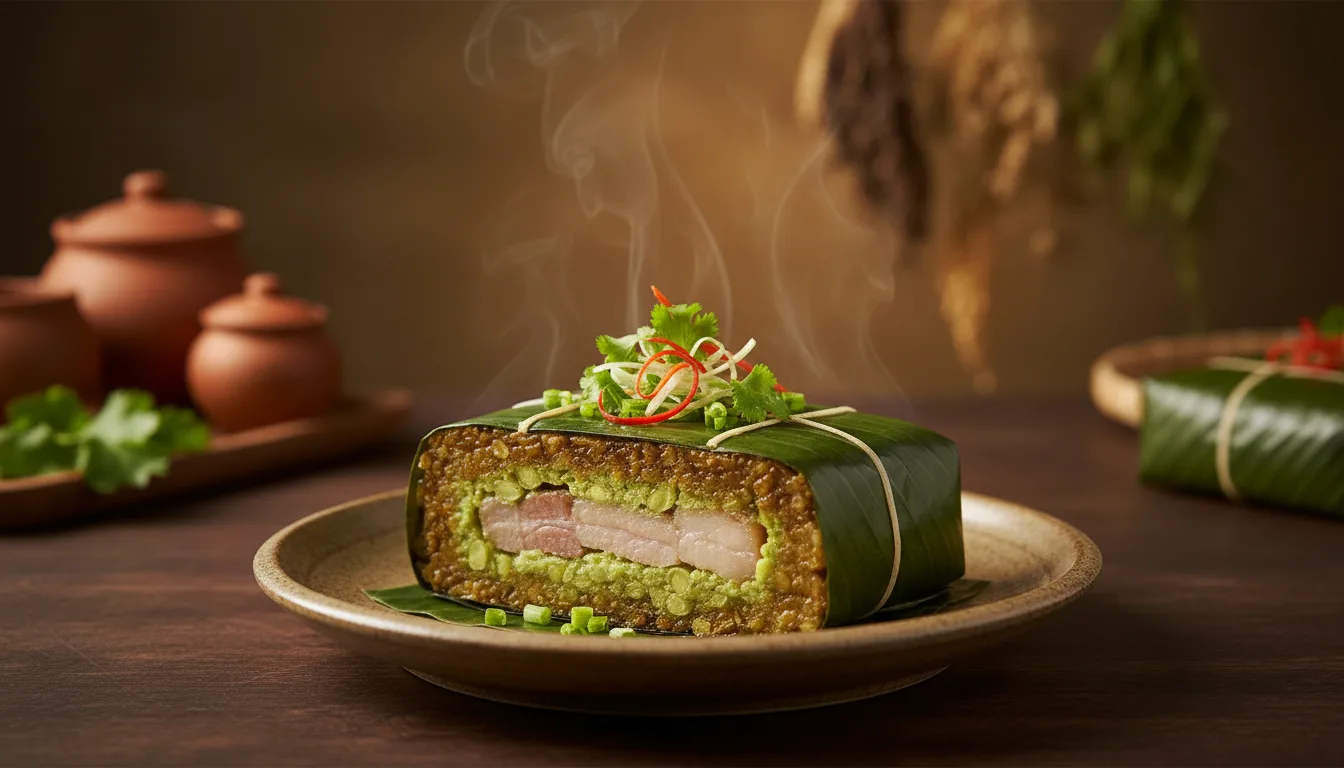
Authentic Bánh Chưng Recipe
Royal Nutritional Ledger *
For those counting their gold coins and their calories.
The Royal Disclaimer: These figures are calculated by our finest AI court scholars based on standard ingredient values. They are highly educated estimates meant for guidance, not gospel. If you require absolute scientific precision for medical or dietary salvation, please consult a certified physician rather than our kitchen AI!
The Grand Lunar New Year & Tết Feast: Prosperity Dumplings, Longevity Noodles & Bánh Chưng
Did You Know?
Historical Tidbit
According to the historic 14th-century chronicle Lĩnh Nam Chích Quái, Prince Lang Liêu of the Sixth Hùng Dynasty invented Bánh Chưng (representing the square Earth) and Bánh Giầy (representing the round Heaven) after a dream from a deity; his humble, edible tribute won him the imperial throne over his wealthy brothers' lavish gifts.
First time here? Click the button above to automatically send all these ingredients to your highest-paying local grocery delivery app.
⚖️ The Modernizer
Missing extinct ingredients? Swap for accessible modern alternatives.
The Golden Rule
"Wrap with military structural firmness, tie the bamboo ribbons with breathing room for starch expansion, and never let the simmering water drop below the cake surface."
Ingredients
18 items required
The Glutinous Rice Foundation:
The Savory Golden Mung Bean Core:
The Black-Pepper Braised Pork Marbling:
The Traditional Northern Wrapping & Boiling Architecture:
Make Us Your Preferred Culinary Source
AI Emergency Hub
Hit a snag while prepping? Our elite AI tools are here to save your dish.
Missing an Ingredient?
Recipe Disaster?
Chef's Notes
The cardinal sin of Bánh Chưng boiling is replenishing evaporating water with cold or lukewarm water. Adding cold water causes a thermal shock that drops the pot temperature below starch gelatinization point, resulting in 'lại gạo'—a catastrophic flaw where the inner rice kernels seize up, recrystallize, and remain permanently raw and chalky. Always keep a rolling kettle of boiling water next to your stockpot.
Pro Tip
For that vibrant, legendary imperial green border, turn the two innermost lá dong leaves so that their waxy, deep-green dorsal sides press directly against the rice grains. During the prolonged 10-hour boil, heat hydrolyzes the leaf cells, depositing high concentrations of natural chlorophyll straight into the outer 3 millimeters of swelling amylopectin, creating an organic jade crust without synthetic dyes.
Kitchen Catastrophe Warning
If a bamboo binding snaps or a leaf tears during the boil, releasing mung bean into the water, immediately lift the cake out with tongs. Do not panic: wrap the hot cake tightly in two layers of heavy-duty aluminum foil, re-secure it with silicone kitchen twine, and drop it back into the boiling cauldron. If a cooled cake cuts open to reveal undercooked rice pockets, cut the entire cake into thick squares and pan-fry them in rendered pork fat into 'Bánh Chưng Rán' (crispy fried sticky rice cakes)—turning a structural failure into Vietnam's most coveted breakfast.
The Jester's Corner
Royal Court Comedy
The Hùng King essentially held the world's first MasterChef elimination challenge, and Lang Liêu won the entire kingdom by serving boiled carbs wrapped in foliage while his brothers spent millions on imported peacock tongues.
The Culinary Science
The 10-hour simmering process triggers full amylopectin gelatinization at 65°C–70°C, breaking hydrogen bonds within the rice granules and transforming them into a unified gel matrix. Simultaneously, the subcutaneous pork lard completely liquefies and permeates the porous mung bean mantle. The final 8-hour cold press expels free capillary water (water activity aw reduction), tightly compressing the retrograded starches into a sterile, hermetic block protected by the antimicrobial polyphenols released from the Phrynium leaves.
Featured in Master Menu Collections
Calibrated by culinary science for foolproof execution and maximum flavor.
Make Us Your Preferred Culinary Source
Prioritize Ages & Spices in your Google Discover, Top Stories, and AI search feed with one tap.
🎭How does this recipe make you feel?
Tap a reaction to share your vibe
General Food Safety & Storage
Storage Science
Cool rapidly. Store in an airtight container in the refrigerator (below 4°C / 40°F). Consume within 3-4 days.
Reheating Science
Reheat to an internal temperature of 165°F (74°C). Use the stove or oven for best texture, stirring or turning occasionally to ensure even heating.
Taster's Notes
Community Feedback
0 Comments
Be the first to leave a note on this recipe!