Authentic Colomba Pasquale Recipe
Royal Nutritional Ledger *
For those counting their gold coins and their calories.
The Royal Disclaimer: These figures are calculated by our finest AI court scholars based on standard ingredient values. They are highly educated estimates meant for guidance, not gospel. If you require absolute scientific precision for medical or dietary salvation, please consult a certified physician rather than our kitchen AI!
The Grand Easter Feast: Spring Lamb Roasts, Simnel Bakes & Global Heirlooms
Did You Know?
Historical Tidbit
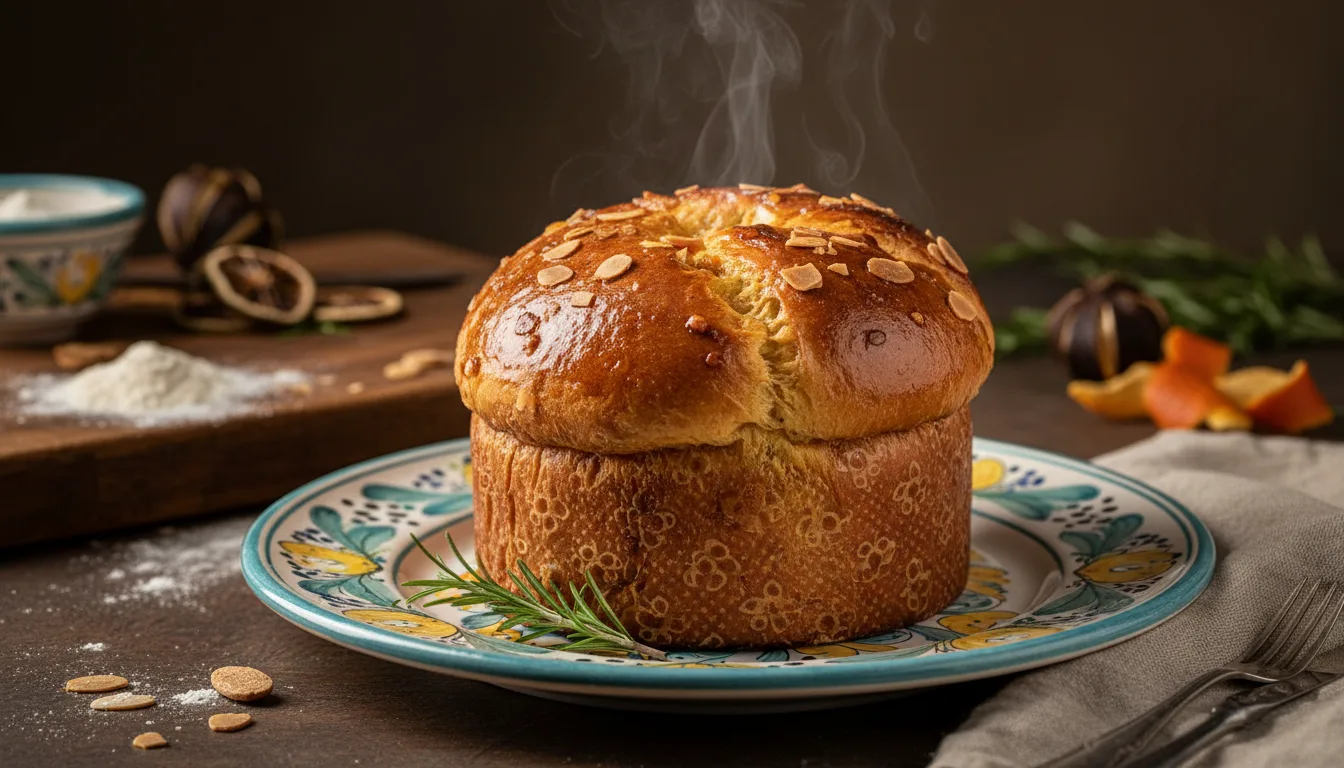
Legend holds that during the 6th-century siege of Pavia, King Alboin was appeased by a local baker who presented sweet dove-shaped loaves as emblems of peace, successfully sparing the city from royal destruction.
First time here? Click the button above to automatically send all these ingredients to your highest-paying local grocery delivery app.
⚖️ The Modernizer
Missing extinct ingredients? Swap for accessible modern alternatives.
The Golden Rule
"Never remove the Colomba from the oven by guess or visual cue; bake strictly to an internal core temperature of 93°C to 94°C (199°F to 201°F)—lower means structural cave-in upon inversion, higher turns your cloud-like crumb into dry sawdust."
Ingredients
34 items required
The Preferment (Biga Aromatica):
The First Dough (Primo Impasto):
The Second Dough (Secondo Impasto):
The Royal Amaretto Glaze (Ghiaccia):
The Regal Crown & Garnish:
Make Us Your Preferred Culinary Source
AI Emergency Hub
Hit a snag while prepping? Our elite AI tools are here to save your dish.
Missing an Ingredient?
Recipe Disaster?
Chef's Notes
The cardinal sin of Colomba making is gluten shear caused by butter temperature negligence. Butter must be precisely pliable (18°C / 64°F)—neither melted liquid nor refrigerator-cold. Cold butter tears the micro-filaments of the developing gluten sheath, while melted butter creates an unrecoverable oily sludge that suffocates yeast cells.
Pro Tip
Always purchase Manitoba flour with a W-rating of 350 to 380 and a protein index of at least 14%. Enriched doughs laden with this volume of butter and egg yolks create excessive gluten drag; standard all-purpose flour lacks the sheer tensile elasticity required to support the massive volume expansion.
Kitchen Catastrophe Warning
If your dough splits or separates into an oily, curdled mess during the butter addition of the Secondo Impasto: Stop the mixer immediately. Place the entire bowl and dough into the refrigerator for 20 minutes to firm up the fat. Return to the mixer and incorporate 1 tablespoon of ice-cold whole milk and 1 tablespoon of Manitoba flour on low speed; the chilled starch and aqueous proteins will rapidly restore the emulsion.
The Jester's Corner
Royal Court Comedy
A baker who refuses to hang their Colomba upside down after baking is simply choosing to serve a very expensive, butter-scented medieval doorstop.
The Culinary Science
The inverted resting technique exploits structural starch retrogradation under negative tensile gravitational stress. As amylose crystallizes during the cooling drop from 94°C to room temperature, the hot gas pockets contract. Hanging the bread upside down ensures gravity pulls the fragile gluten cell walls elongated rather than collapsing downward into a dense, gummy layer.
Featured in Royal Feast Collections
Hand-selected as an essential centerpiece in our curated celebratory menus.
Make Us Your Preferred Culinary Source
Prioritize Ages & Spices in your Google Discover, Top Stories, and AI search feed with one tap.
🎭How does this recipe make you feel?
Tap a reaction to share your vibe
Starch Retrogradation Reversal
Storage Science
Store at room temperature in a breathable bread bag or paper wrapper for up to 2 days. DO NOT refrigerate, as the cold accelerates starch retrogradation (staling). For long-term storage, freeze tightly wrapped.
Reheating Science
To reverse staling, flick a few drops of water onto the crust and reheat in a 350°F (175°C) oven for 5-8 minutes. The steam will re-gelatinize the starches, making the crumb soft and the crust crisp.
Taster's Notes
Community Feedback
0 Comments
Be the first to leave a note on this recipe!