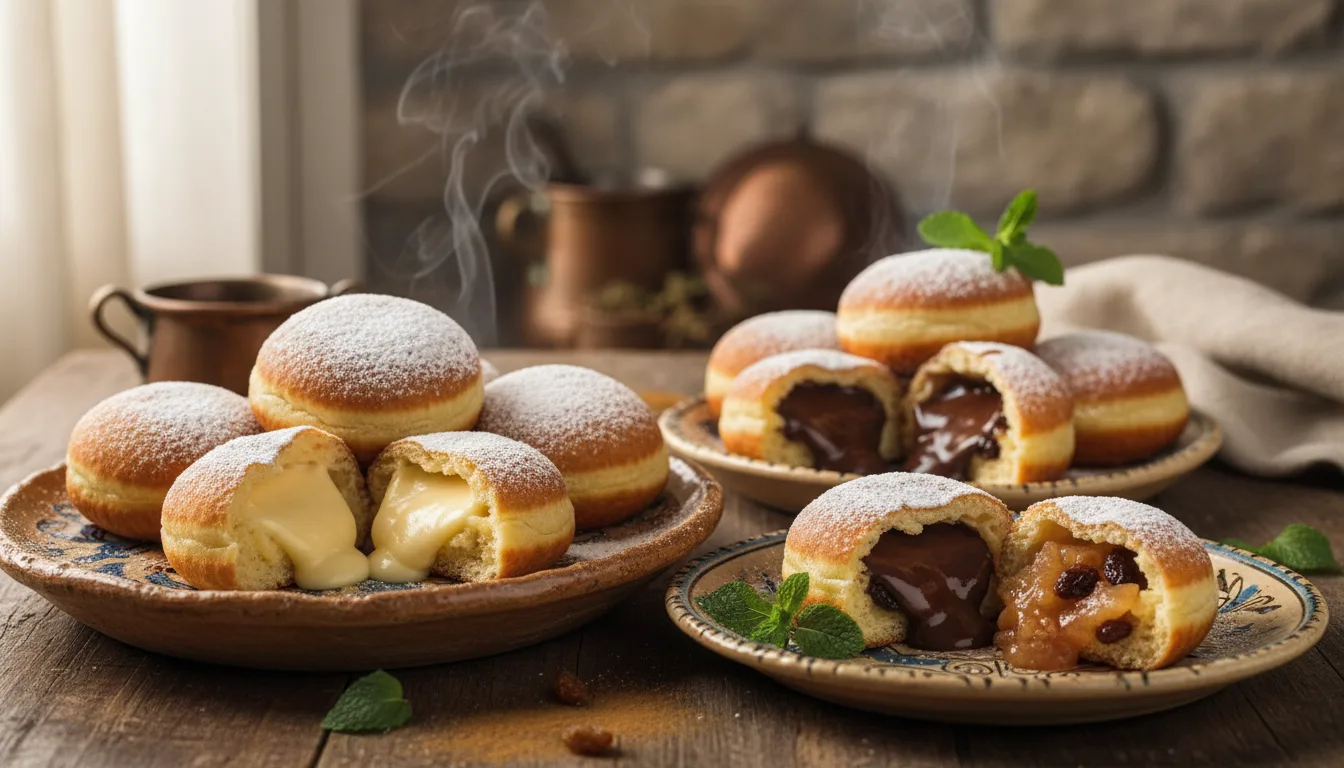
Authentic Filled Venetian Fritole Variations
Royal Nutritional Ledger *
For those counting their gold coins and their calories.
The Royal Disclaimer: These figures are calculated by our finest AI court scholars based on standard ingredient values. They are highly educated estimates meant for guidance, not gospel. If you require absolute scientific precision for medical or dietary salvation, please consult a certified physician rather than our kitchen AI!
Part of our Recipe variant Master Index
Did You Know?
Historical Tidbit
Venetian Fritole (or Frìtole) were proclaimed the official National Pastry of the Republic of Venice (Serenissima) by the Doge in the 18th century, strictly regulated by an exclusive guild known as the 'Fritoleri'.
First time here? Click the button above to automatically send all these ingredients to your highest-paying local grocery delivery app.
⚖️ The Modernizer
Missing extinct ingredients? Swap for accessible modern alternatives.
The Golden Rule
"Never crown or crowd your frying vessel: fry in small batches of no more than five or six fritole, and always roll them in superfine caster sugar while boiling-hot so the crystals melt partially into the micro-crust."
Ingredients
30 items required
The Enriched Yeasted Fritole Dough:
The Thermal Frying Medium:
Variation 1: Crema Pasticciera (Classic Venetian Vanilla-Citrus Custard):
Variation 2: Crema allo Zabaione (Royal Fortified Marsala Custard):
The Royal Finishing Cloak:
Make Us Your Preferred Culinary Source
AI Emergency Hub
Hit a snag while prepping? Our elite AI tools are here to save your dish.
Missing an Ingredient?
Recipe Disaster?
Chef's Notes
The catastrophic pitfall of fritole frying is oil temperature neglect. If your frying fat drops below 165°C (330°F), the soft, enriched dough will act like a maritime sponge, soaking up sickening quantities of oil; if it exceeds 175°C (347°F), the exterior sugar will caramelize and burn to black carbon before the dense, yeasted core has fully cooked through, leaving you with raw, molten dough encased in a scorched shell. Use a reliable digital probe or clip-on candy thermometer throughout the entire process.
Pro Tip
The inclusion of high-proof Venetian Grappa is not just aromatic bravado—it is essential culinary physics. Alcohol evaporates at 78°C (172°F), far below the boiling point of water. The instantaneous flash-vaporization of ethanol creates thousands of microscopic steam cavities inside the batter upon contact with 170°C oil, resulting in an ethereal, cloud-like interior crumb while forming an outward vapor pressure barrier that physically halts oil penetration into the crumb.
Kitchen Catastrophe Warning
If you test your first fritola and discover a gooey, undercooked core despite a deeply browned exterior, your oil is running too hot (above 175°C / 347°F). Immediately cut the flame to bring the oil down to 168°C (334°F). Rescue any undercooked batch immediately: arrange them on a wire rack and place them into an oven preheated to 160°C (320°F) for 4 to 5 minutes to allow heat conduction to set the interior starch matrix, then sugar and inject the fillings as planned.
The Jester's Corner
Royal Court Comedy
The Venetian Doge signed a decree guaranteeing fritole perfection because nothing sparks a naval mutiny faster than a hollow, greasy ball of half-fried dough.
The Culinary Science
Cornstarch retrogradation and fat emulsification govern the fillings: heating the pastry cream to 82°C fully gelatinizes amylose and amylopectin starches without denaturing the egg proteins into scrambled curds. Meanwhile, when the fritole drop into 170°C oil, the rapid Maillard reaction between reducing sugars (fructose/glucose from milk and sugar) and free amino acids in the egg proteins produces hundreds of melanoidin compounds, yielding the quintessential hazelnut-caramel aroma characteristic of authentic Carnevale.
Explore Curated Feast Collections
Discover 90+ themed festive banquets, seasonal menus, and imperial regional feasts.
Make Us Your Preferred Culinary Source
Prioritize Ages & Spices in your Google Discover, Top Stories, and AI search feed with one tap.
🎭How does this recipe make you feel?
Tap a reaction to share your vibe
General Food Safety & Storage
Storage Science
Cool rapidly. Store in an airtight container in the refrigerator (below 4°C / 40°F). Consume within 3-4 days.
Reheating Science
Reheat to an internal temperature of 165°F (74°C). Use the stove or oven for best texture, stirring or turning occasionally to ensure even heating.
Taster's Notes
Community Feedback
0 Comments
Be the first to leave a note on this recipe!