The Ultimate 2-Ingredient Chocolate Mousse Cake Recipe
Royal Nutritional Ledger *
For those counting their gold coins and their calories.
The Royal Disclaimer: These figures are calculated by our finest AI court scholars based on standard ingredient values. They are highly educated estimates meant for guidance, not gospel. If you require absolute scientific precision for medical or dietary salvation, please consult a certified physician rather than our kitchen AI!
The Viral Kitchen Phenomenon: Internet-Famous Recipes Mastered by Science
Did You Know?
Historical Tidbit
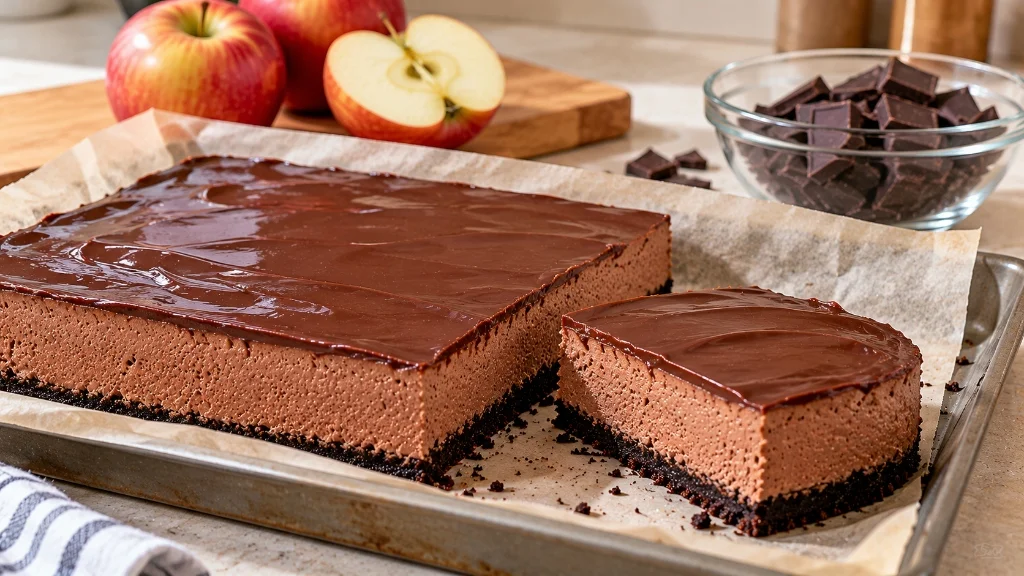
The combination of apples and dark chocolate is a scientifically verified flavor affinity: both ingredients share high concentrations of catechin polyphenols and aromatic aldehydes, which is why the apple flavor seamlessly melds into the cocoa without tasting fruity.
First time here? Click the button above to automatically send all these ingredients to your highest-paying local grocery delivery app.
⚖️ The Modernizer
Missing extinct ingredients? Swap for accessible modern alternatives.
The Golden Rule
"Steam the apples until fork-tender, blend while steaming hot with warm chocolate, and let the refrigerator freeze time into velvet."
Ingredients
10 items required
The Canonical 2 Ingredients:
The Essential Culinary Facilitators:
The Optional Glossy Mirror Glaze (As seen in presentation):
Make Us Your Preferred Culinary Source
AI Emergency Hub
Hit a snag while prepping? Our elite AI tools are here to save your dish.
Missing an Ingredient?
Recipe Disaster?
Chef's Notes
**Why Sweet Apples are Non-Negotiable**: Never make this recipe with sour green Granny Smith apples! Tart cooking apples have high malic acid and low natural fructose, which makes the dark chocolate taste aggressively bitter and acidic. Use sweet, dense red apples like Honeycrisp, Gala, or Fuji; their natural fructose perfectly balances the 70% cocoa solids without needing a single grain of refined sugar. **The High-Speed Blender Requirement**: A standard food processor or handheld immersion blender lacks the shear RPM velocity needed to break apple cellular walls down to sub-micron smoothness. A high-speed blender is essential to pulverize the apple fibers so that nobody can detect a hint of fruit texture—the palate registers only dense, velvety chocolate mousse!
Pro Tip
1. **Steaming Hot Blending**: Blend the apples while they are still hot from the pot with the warm melted chocolate. If you blend cold apples with warm chocolate, the cocoa butter will shock-freeze and seize into grainy chocolate sand before emulsifying. 2. **Cocoa Percentage Rule**: Use 70% to 75% dark chocolate for the best balance of cocoa butter and sweetness. Milk chocolate has too much dairy fat and sugar, which prevents the pectin from forming a firm, sliceable cake structure. 3. **The Hot Knife Slice**: To achieve those razor-sharp, bakery-style edges seen in the photo: dip a long chef's knife in boiling water for 10 seconds, wipe it completely dry on a clean towel, and slice in one smooth downward draw. Wipe and reheat the knife between every cut!
Kitchen Catastrophe Warning
**Disaster — The Mixture Seized in the Blender into Grainy Chocolate Clumps**: Your apples cooled down before you added the chocolate, causing the cocoa butter to instantly solidify into stiff, grainy clay. **The Rescue**: Do not throw it away! Add 60 ml / 4 tbsp of hot boiling water directly into the blender jar. Pulse 5 times, then blend on HIGH for 60 seconds. The boiling water will melt the seized cocoa butter crystals and re-emulsify the mixture into a glossy, pourable mousse! Pour into your pan and chill as directed.
The Jester's Corner
Royal Court Comedy
Telling someone that their decadent French chocolate mousse cake is made entirely of steamed apples is the ultimate culinary trust-fall experiment.
The Culinary Science
**1. Pectin-Cocoa Butter Colloidal Co-Gelation**: Apple cell walls are rich in high-methoxyl pectin, a structural polysaccharide composed of alpha-(1-4)-linked D-galacturonic acid units. Steaming hydrolyzes protopectin into soluble pectin. When blended at high shear with dark chocolate, the hydrophobic fatty acids of cocoa butter (stearic, palmitic, and oleic acids) disperse into micro-droplets surrounded by the pectin-water matrix. **2. Form V Cocoa Butter Polymorphism**: As the cake cools in the refrigerator, cocoa butter triglycerides undergo polymorphic crystallization into the stable Form V (Beta) crystalline state, which has a melting point of 34°C (93°F). This means the cake remains firm and sliceable at refrigerator temperature, but melts luxuriously on the tongue the moment it enters the mouth ($37^\circ\text{C} / 98.6^\circ\text{F}$).
Featured in Master Menu Collections
Calibrated by culinary science for foolproof execution and maximum flavor.
🏺 Explore More Royal Feasts
Lift the lid on these timeless delicacies
Make Us Your Preferred Culinary Source
Prioritize Ages & Spices in your Google Discover, Top Stories, and AI search feed with one tap.
🎭How does this recipe make you feel?
Tap a reaction to share your vibe
Pastry & Confectionery Stabilization
Storage Science
Cakes and soft desserts should be wrapped tightly to prevent moisture loss and stored at room temperature (if no perishable fillings) or refrigerated. Consume within 3 days.
Reheating Science
Serve at room temperature for optimal flavor perception, as cold mutes sweetness. If it's a baked pastry, flash-heat in a 350°F (175°C) oven for 3-5 minutes to restore the butter matrix and crispness.
Taster's Notes
Community Feedback
0 Comments
Be the first to leave a note on this recipe!