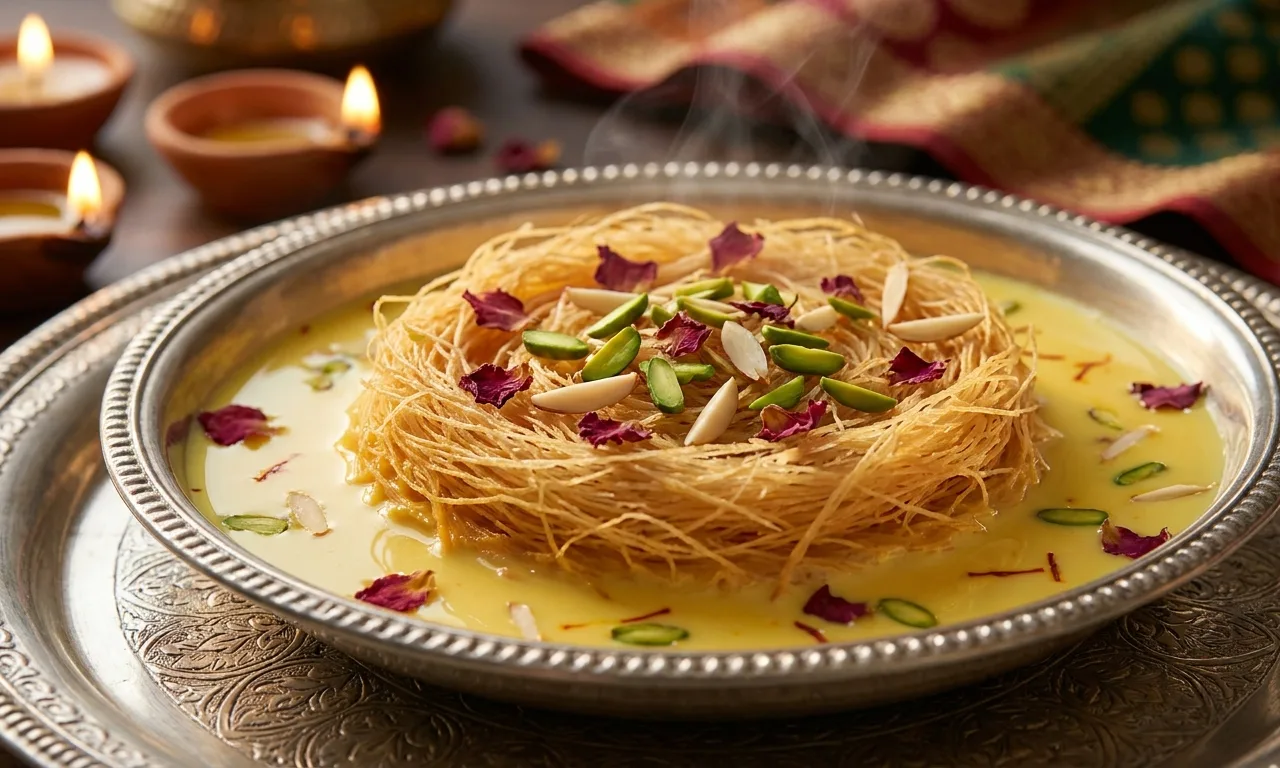
The Ultimate Sargi Pheni Recipe (Shredded Wheat in Sweet Milk)
Royal Nutritional Ledger *
For those counting their gold coins and their calories.
The Royal Disclaimer: These figures are calculated by our finest AI court scholars based on standard ingredient values. They are highly educated estimates meant for guidance, not gospel. If you require absolute scientific precision for medical or dietary salvation, please consult a certified physician rather than our kitchen AI!
The Karwa Chauth Master Food Guide & Sargi Menu
Did You Know?
Historical Tidbit
Sargi is the sacred pre-dawn meal gifted by mothers-in-law to daughters-in-law on Karwa Chauth, eaten before the crack of sunrise (typically before 4:30 AM) to sustain a day-long waterless fast.
First time here? Click the button above to automatically send all these ingredients to your highest-paying local grocery delivery app.
⚖️ The Modernizer
Missing extinct ingredients? Swap for accessible modern alternatives.
The Golden Rule
"Never, under any circumstance, boil pheni in the pot with the milk; always rest the pheni in the bowl and pour hot simmering milk over it immediately prior to consumption."
Ingredients
12 items required
The Aromatic Saffron Milk:
The Gossamer Wheat Coils:
The Royal Nut Garnish:
Make Us Your Preferred Culinary Source
AI Emergency Hub
Hit a snag while prepping? Our elite AI tools are here to save your dish.
Missing an Ingredient?
Recipe Disaster?
Chef's Notes
Pheni is fundamentally distinct from standard vermicelli (seviyan) or falooda sev—it is hand-stretched and pre-fried in pure desi ghee into micro-thin, porous nests. Never boil the pheni inside the milk pot like kheer; doing so obliterates the delicate structural lamination, transforming royal gossamer strands into gummy porridge. Pouring hot milk over the coils in the serving bowl preserves individual strand integrity.
Pro Tip
Always crush the saffron threads between your fingertips before blooming in lukewarm milk to maximize crocin extraction and achieve an even, radiant hue.|||Select artisanal ghee-fried pheni that smells sweet and buttery rather than stale or oxidized, as pre-fried pheni can turn rancid quickly if stored improperly.|||Serve immediately within 2 minutes of pouring the hot milk; this ensures the outer layers absorb the fragrant milk while retaining a subtle textural bite in the core.
Kitchen Catastrophe Warning
Disaster: The pheni was added directly to boiling milk and has dissolved into a gluey, thick mash. Salvage: Instantly pull the pan off the heat, whisk in 200 ml of cold heavy cream or chilled condensed milk, and chill it completely in the freezer for 20 minutes to transform it into a chilled Pheni Rabdi Pudding; garnish heavily with toasted nuts to reintroduce essential crunch.
The Jester's Corner
Royal Court Comedy
Waking up at 4:00 AM to eat a bowl of rich, ghee-laden pheni while half-asleep is the only time in adult life where eating dessert in pitch darkness is considered a sacred duty.
The Culinary Science
Pheni undergoes deep-frying in ghee during its manufacture, which gelatinizes the wheat starch and coats the gluten matrix in saturated fats. When hot milk (around 85°C to 90°C) is poured over the pheni, capillary action rapidly pulls liquid into the porous voids, causing instant hydration without breaking down the fat-stabilized gluten network. Boiling it directly would emulsify the fats excessively and rupture starch granules, resulting in unwanted pasty retrogradation.
Featured in Master Menu Collections
Calibrated by culinary science for foolproof execution and maximum flavor.
Make Us Your Preferred Culinary Source
Prioritize Ages & Spices in your Google Discover, Top Stories, and AI search feed with one tap.
🎭How does this recipe make you feel?
Tap a reaction to share your vibe
General Food Safety & Storage
Storage Science
Cool rapidly. Store in an airtight container in the refrigerator (below 4°C / 40°F). Consume within 3-4 days.
Reheating Science
Reheat to an internal temperature of 165°F (74°C). Use the stove or oven for best texture, stirring or turning occasionally to ensure even heating.





Taster's Notes
Community Feedback
0 Comments
Be the first to leave a note on this recipe!