The Ultimate Kharna Ghee Roti Recipe
Royal Nutritional Ledger *
For those counting their gold coins and their calories.
The Royal Disclaimer: These figures are calculated by our finest AI court scholars based on standard ingredient values. They are highly educated estimates meant for guidance, not gospel. If you require absolute scientific precision for medical or dietary salvation, please consult a certified physician rather than our kitchen AI!
The Sacred Chhath Puja Mahaparv Food & Prasad Guide
Did You Know?
Historical Tidbit
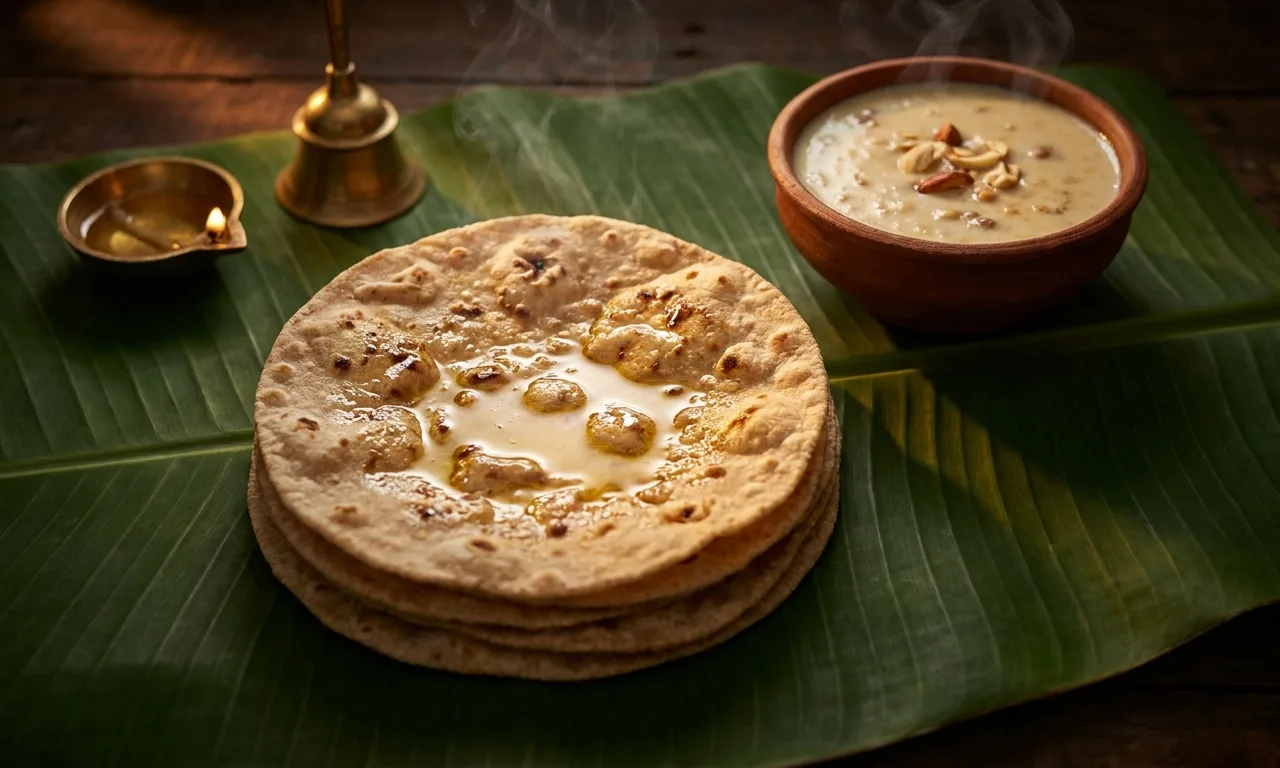
On the holy night of Kharna, these rotis are traditionally baked over clay chulhas using fragrant dried mango wood fire, which imbues the bread with an inimitable smoky essence.
First time here? Click the button above to automatically send all these ingredients to your highest-paying local grocery delivery app.
⚖️ The Modernizer
Missing extinct ingredients? Swap for accessible modern alternatives.
The Golden Rule
"Knead the dough softer than conventional chapati dough and let it rest; inadequate hydration and unrelaxed gluten strands will fracture under steam pressure, preventing the sacred balloon from forming."
Ingredients
7 items required
The Sacred Dough:
The Dusting Element:
The Divine Anointment:
Make Us Your Preferred Culinary Source
AI Emergency Hub
Hit a snag while prepping? Our elite AI tools are here to save your dish.
Missing an Ingredient?
Recipe Disaster?
Chef's Notes
Kharna roti is distinct from everyday phulkas—it must be neither bone-dry nor oily during the griddle stage. Cooking occurs completely dry on an unseasoned raw surface so that the flour retains an earthy, pristine char. The ghee is only applied post-roast, and solely to one presentation face, soaking into the micro-fissures created by the steam while sealing in moisture for hours of religious reverence.
Pro Tip
Keep the tawa smoking hot; if the iron is tepid, the dough dehydrates slowly and turns into a brittle, leathery disc instead of inflating. When rolling, never apply force directly to the center—apply featherlight pressure strictly to the edges to preserve uniform thickness that facilitates an instant, unhindered steam pocket.
Kitchen Catastrophe Warning
If your roti comes off the pan tough, stiff, and card-like instead of pillow-soft, the tawa heat was too low or you over-dusted with raw flour. To salvage the remaining batch, spritz the dough with a teaspoon of warm water, re-knead for two minutes, dramatically increase tawa heat, and vigorously slap excess dry flour off each rolled disc before it hits the skillet.
The Jester's Corner
Royal Court Comedy
The ultimate test of Bihari family diplomacy: attempting to decide which sibling receives the sacred puffed roti that got three tablespoons of ghee instead of one.
The Culinary Science
Puffing relies on flash-vaporization and starch gelatinization: high ambient contact heat rapidly seals the outer starch matrix, preventing steam from escaping. The internal free water boils instantly into steam (expanding to over 1,600 times its liquid volume), cleaving the upper and lower structural layers apart to create the hollow central envelope.
Featured in Master Menu Collections
Calibrated by culinary science for foolproof execution and maximum flavor.
Make Us Your Preferred Culinary Source
Prioritize Ages & Spices in your Google Discover, Top Stories, and AI search feed with one tap.
🎭How does this recipe make you feel?
Tap a reaction to share your vibe
Starch Retrogradation Reversal
Storage Science
Store at room temperature in a breathable bread bag or paper wrapper for up to 2 days. DO NOT refrigerate, as the cold accelerates starch retrogradation (staling). For long-term storage, freeze tightly wrapped.
Reheating Science
To reverse staling, flick a few drops of water onto the crust and reheat in a 350°F (175°C) oven for 5-8 minutes. The steam will re-gelatinize the starches, making the crumb soft and the crust crisp.

Taster's Notes
Community Feedback
0 Comments
Be the first to leave a note on this recipe!